This plant grows close to the ground, with only its yellow attractive flowers growing on long stalks. The flowers open during the day and close when it gets dark.
Status: Least concern, Introduced (East Asian origin)
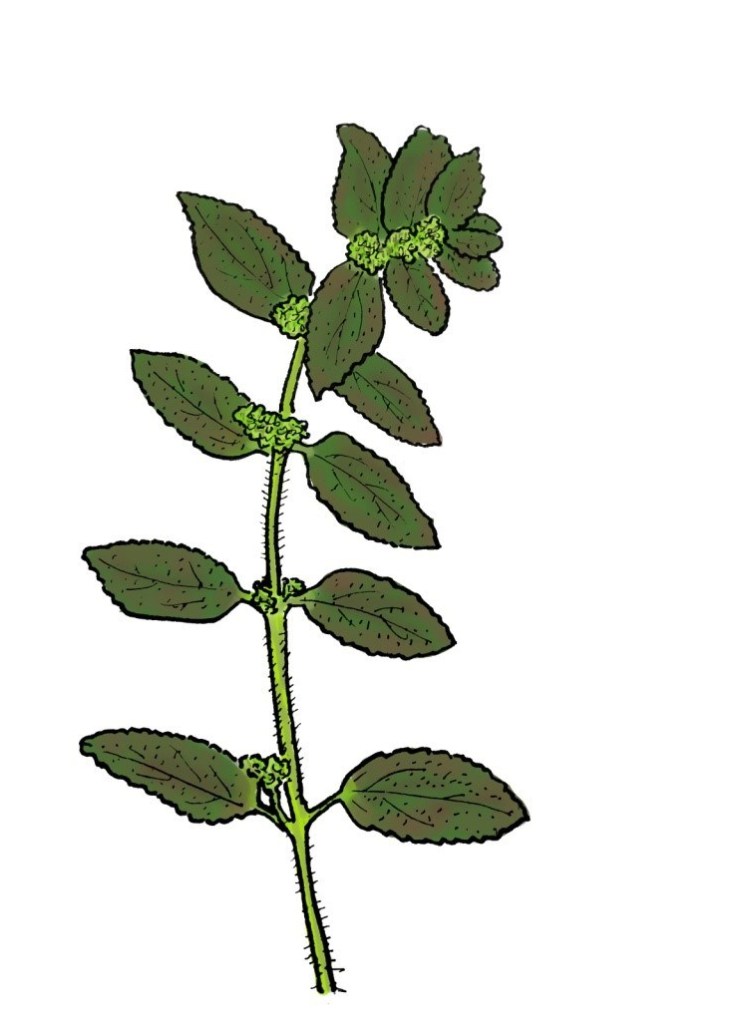
A small, hardy plant with dull green or purplish-green leaves. The leaves are arranged opposite each other and have toothed margins. Its flowers are tiny and green, growing in clusters between the leaves. It grows on lawns and roadsides.
Status: Least concern, Naturalised (Possibly Indian origin)
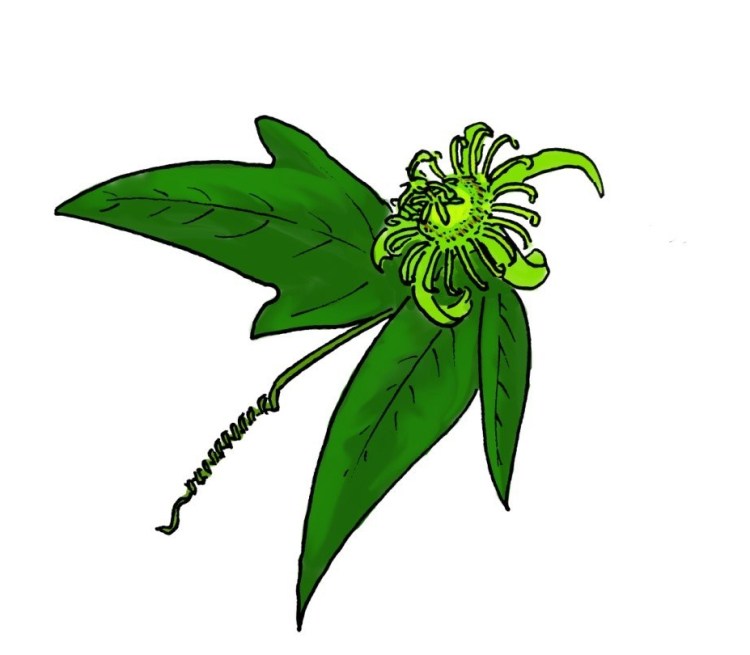
A common vine with pale green flowers. It has coiled tendrils for gripping and sometimes grows over other plants, smothering them. Its leaves have different shapes: some are long and narrow, and others are three-lobed. It produces dark-blue, berry-like fruits.
The term rewilding has been thrown about a lot quite recently but in many cases, the term has been misused to just be about planting trees. Here I explain how ecologists view rewilding, as well as important concepts required to understand rewilding. This is somewhat a summary of a review paper by Perino et al. (2019). If you want to read something more technical you can find the details of that paper in the references below.
Rewilding is not only about introducing wild things to where they can’t be found anymore. To quote Dave Foreman:
“I meant rewilding to instead be about wilderness restoration – restoring wildness with native species and processes. So, let us all remember that rewilding comes from wilderness recovery (or restoration).”
In other words, the goal of rewilding is to restore functions to ecosystems through the reintroduction of native species. This is the main difference between rewilding and ecological restoration, which focuses on the restoration of ecosystem functions without the emphasis on reintroducing native species. This does not mean that ecological restoration is worse; in locations where invasive species are impossible to eliminate or native species cannot be reintroduced, ecological restoration is a more viable option.
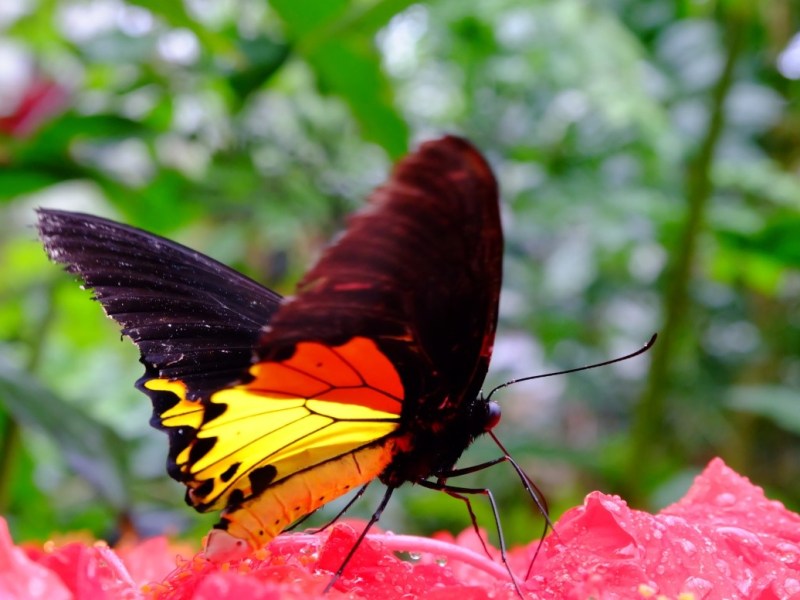
What is an ecological function? An example would be a butterfly, which as an adult serves as a pollinator for flowering plants, while, as a caterpillar, it functions as prey for insect-eating birds and a host for parasitoid wasps.
Restoring ecological functions drives 3 processes (simple terms are in bold, scientific terms are in brackets):
Food chains (Trophic complexity)
Disturbance (Stochastic disturbance)
Movement (Dispersal)
Plants, fungi and animals with a lot of ecological functions create a complex web of interactions. Among these interactions are food chains. This is the process in which energy is stored and moved throughout the ecosystem. The more complex the food chains or food webs, the more stable and resilient the ecosystem will be. This is why rewilding efforts can start with first reintroducing predators back into ecosystems. For example, in Yellowstone National Park in the United States, wolves were reintroduced back into the park first, to regain ecosystem balance. By doing so, you add another level to the food chain and the lower levels of the food chain are regulated by the predators on the upper levels.
We tend to think of disturbance as a bad thing, but that is not always the case in a dynamic system. Random disturbance events help to make ecosystems more diverse and stable by ensuring that no one organism can dominate. For example, in rainforests, large trees will grow and block sunlight from reaching the understory. If the large trees do not die – through falling over, disease, lightning strikes or fire – then there will not be any new space for younger trees to grow. So a forest is not a permanent collection of trees, but it is in a constant state of change in which large trees fall and new trees fill the gaps. This prevents a single tree species from taking over in a rainforest, as many different species fill the niches that become available after a tree fall.
Random disturbance events help to make ecosystems more diverse and stable by ensuring that no one organism can dominate.
Movement is crucial for maintaining the food chains when disturbance happens. Ecosystems are often patches of resources that animals, fungi and plants can use. Usually, this results in patches with different compositions of species. For example, if there are many species in a single large patch, it can help to rescue populations in other smaller patches through the movement of organisms between patches.
This is why creating networks of patches that enable movement between patches is important. It helps to maintain the food chains in all the connected patches by buffering the random disturbance.
On a large scale, preserving ecological functions pays humans back in the form of ecological services. The previous example of a butterfly supplies the supporting service of pollination. This is necessary for the provisioning services which create food and raw materials for people.
Overall ecological services can be categorised into 3 benefits:
Non-material
Material
Regulating
Non-material benefits are things like improvements to human health and wellbeing that can be gained through interactions with nature. Non-material benefits also extend to profits from services such as tourism.
Material benefits are things that you can harvest from nature, such as wood or food. Malaysians have a very close relationship with many species of plants that are used in our culture and cuisine.
Regulating benefits are things that are controlled by having nature around. These include natural disasters like floods and landslides, regulation of heat and climate, and reduction of dust and pollution.
When you have many ecological functions, all these interactions create an ecosystem. Ecosystems, by definition, are living and non-living components interacting in a shared space. The goal of rewilding should always be to restore ecosystems, and that is why we have to be careful about how we use this term and not use it as a buzzword that means only planting trees.
In the next article, I give an example of a successful case of urban rewilding in relation to food chains and interactions, and the lessons we can learn from it, especially from a functional ecology perspective.
Perino, A., Pereira, H. M., Navarro, L. M., Fernández, N., Bullock, J. M., Ceaușu, S., … & Pe’er, G. (2019). Rewilding complex ecosystems. Science, 364(6438), eaav5570.
Here I explain how you can think about ecosystems and how to restore them. The case study of the Golden Birdwing Butterfly, which can be found in the urban forest patch that is Rimba Ilmu Botanic Garden located inside the University of Malaya. Merely reintroducing a species does not produce long lasting results. Butterfly farms…
Draco gliding lizards are interesting tropical animals. They have ‘wings’ that fold out from their ribs and allow them to glide from tree to tree. They also have a small flap under their chins that acts as both a flag to communicate and like the tail of a plane to stabilise their flight. When I read about them as a kid, they always struck me as incredibly exotic animals that would be really hard to find. It turns out that they are quite well adapted to living in our cities.
There are 11 species of Draco in Peninsular Malaysia. In the natural world, they tend to be found in forest clearings where there is space between trees and not too much dense vegetation. These gaps between trees are usually created by tree fall events. In a mature rainforest, trees fall very often, either due to old age, disease, or unstable soil. Rainforest trees are often connected to other trees by vines or lianas, so when one tree goes down, it can pull down others and crush anything smaller in its path. This is a natural disturbance that creates gaps in the otherwise dense canopies of the rainforest. Young trees and saplings use this opportunity to fill the gap and start the cycle over again.
Liana have long, woody winding stems that climb up vertical structures like trees, thus extending from the ground to high canopies
Many species are known to take advantage of these forest gaps, including gliding lizards. The constant disturbance of tree falls creates more diverse patches of forest, where trees of different species and ages are always going through tree falls and regrowth, nothing staying permanent. This, in turn, creates space for all sorts of gap species that are adapted to these environments. The layperson may view change and disturbance as something undesirable or negative, but these are necessary processes to keep the ecosystem in balance.
In cities, humans are the main force of disturbance. We cut weeds and shrubs and maintain clear gaps between trees. While this may not be good for animals that prefer some shelter, the lack of dense vegetation seems to be a boon for gliding lizards. They can bask in the sunlight created by our sparsely planted trees and glide in between them with ease. Scientists call this pre-adaptation – an organism is predisposed to survive in certain habitat structures, allowing it to take advantage of new habitats with similar features.
A lot of our urban species have, by luck of the draw, found a place for themselves in our urban spaces. So perhaps we should ask the question of how we should use disturbance as a tool for biodiversity and healthier ecosystems, instead of maintaining landscapes just for the sake of maintaining aesthetic practices.
References:
Whitmore, T. C. (1984). Tropical rain forests of the Far East. Oxford University Press, Oxford.
Grismer, L. L. (2008). A revised and updated checklist of the lizards of Peninsular Malaysia. Zootaxa, 1860(1), 28-34.
The simplest method is to not do anything and let a patch regrow with wild plants. You can remove any unwanted or dangerous plants through weeding, but there is not much maintenance involved with these patches. A wildflower patch that needs to be tended by humans is an oxymoron.
If you want a bit more control over which wildflowers grow in your patch. You can harvest seeds from existing patches of wildflowers and scatter them into your plot. Wildflowers from the dandelion family (Asteraceaa) have dandelion like seeds that you can blow into your patch. Others have small seeds, fruit or pods that you can harvest when the turn mature and brown. Just break the pods and release the seeds onto the surface of your patch.
Transplanting wildflowers is a bit risky since they wilt very fast. Try to not expose the roots of the plants and collect it with its surrounding soil. Make sure that your patch is moist and watered regularly during the first few days to ensure that your plants don’t dry out. Some wildflowers grow by runners and can be planted similar to transplanting.
Not all your flowers might survive, but that’s perfectly fine. All plants require the correct amount of shade and the correct soil type. In other cases some of your plants will be outcompeted by other wildflowers or eaten by herbivores. These are all good learning opportunities to understand the ecology of these flowers better.
Try to allow a mix of different wildflower species to grow in your patch. This will make it more resilient and beneficial to the soil, as well as more useful to wildlife that forage for food in the patch.
Here I explain how you can think about ecosystems and how to restore them. The case study of the Golden Birdwing Butterfly, which can be found in the urban forest patch that is Rimba Ilmu Botanic Garden located inside the University of Malaya.
Merely reintroducing a species does not produce long lasting results. Butterfly farms all over the country constantly have to restock wild caught butterflies due to captive butterflies dying and not reproducing. When an animal is placed in a system that does not meet its needs, there’s nothing much that it can do except go extinct.
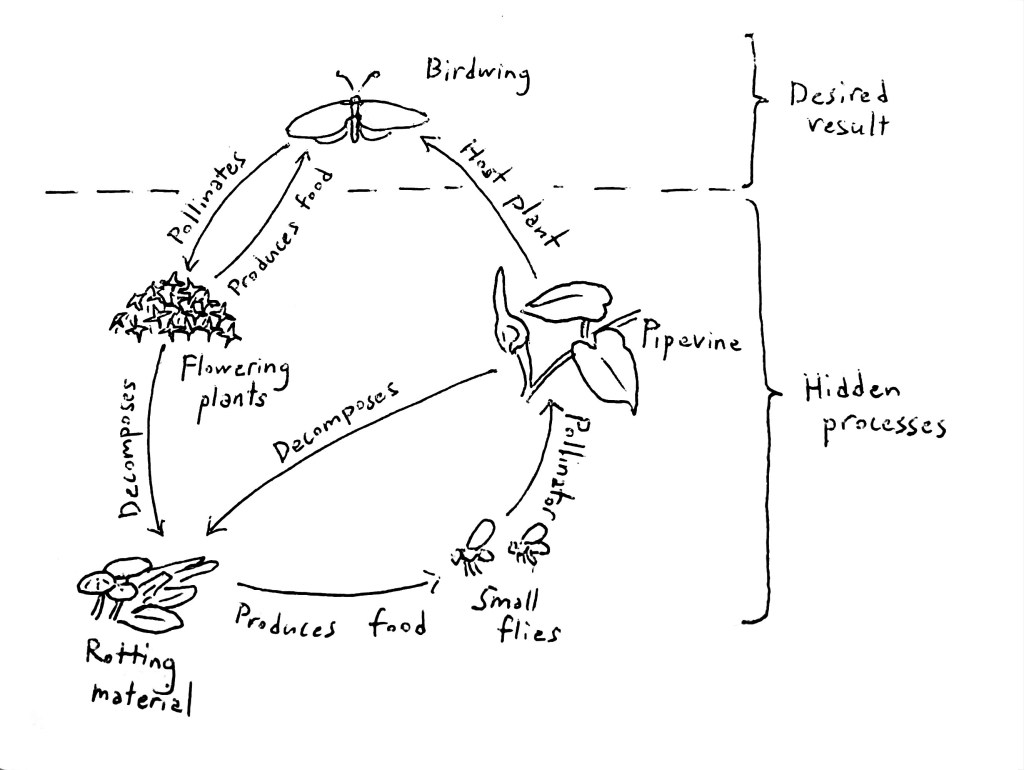
The secret to the birdwings survival is the fact that it has a functioning ecosystem that produces resources can satisfy its ecological requirements.
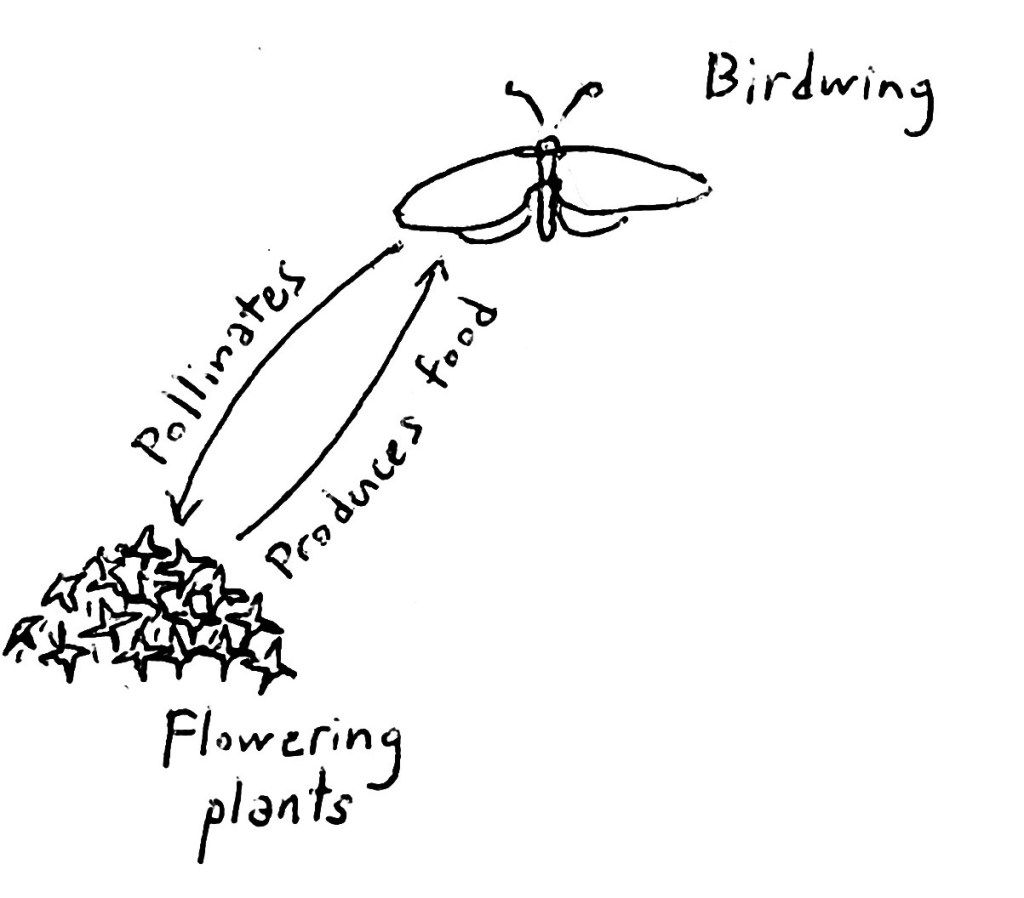
In a butterfly farm, the basic requirements for survival are met; the temperatures are suitable and there is enough food supplied through cut flowers and fruit. The ecosystem in a butterfly farm looks like this:
To be more sustainable and reduce the cost of having to feed the birdwings, you could plant food plants for the birdwings, so they can feed on the nectar. Birdwings prefer flowers that grow on in large clusters like Saraca, Ixora and Bauhinia kockiana so they can walk along and feed. The ecosystem would look this this:
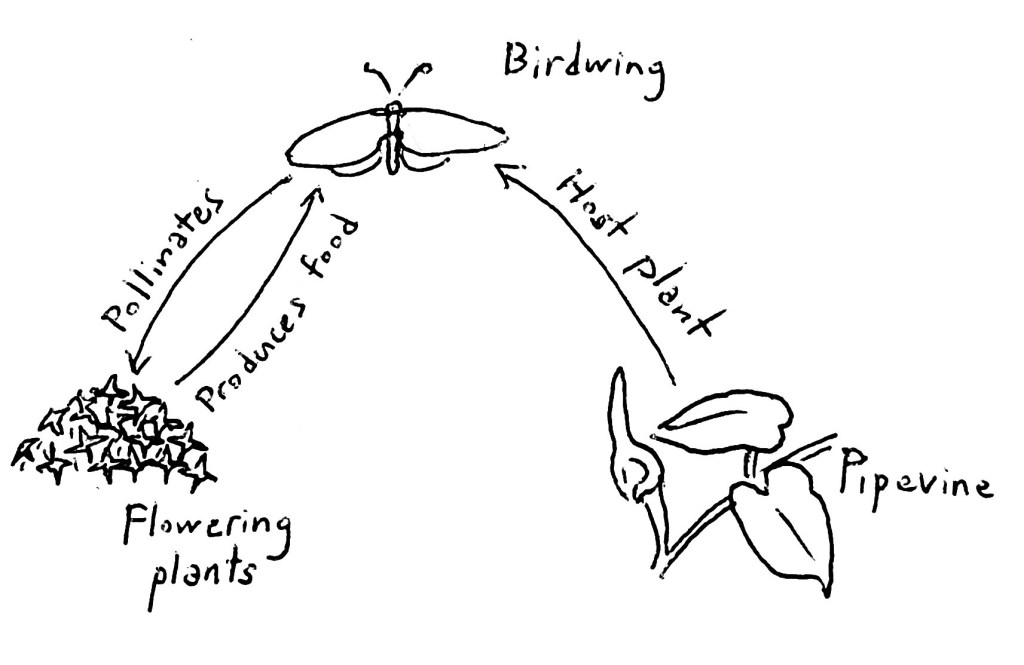
As mentioned before, once the end of the lifespan of the butterfly is reached the ecosystem collapses. This is because all butterflies require a host to develop on as a caterpillar, in this case the Birdwings are breeding on a climbing plant known as Pipevine (Aristolochia tagala). If supplied with a host plant, the butterflies can lay their eggs and reproduce and create a new generation. This ecosystem would look like this:
However, Birdwing caterpillars damage the stem once they are about to pupate into a butterfly. This behaviour is believed to increase the nutrient density of the leaves while reducing the water content. Because of that, the above ecosystem will also eventually collapse after enough caterpillars damage and kill off all their hosts.
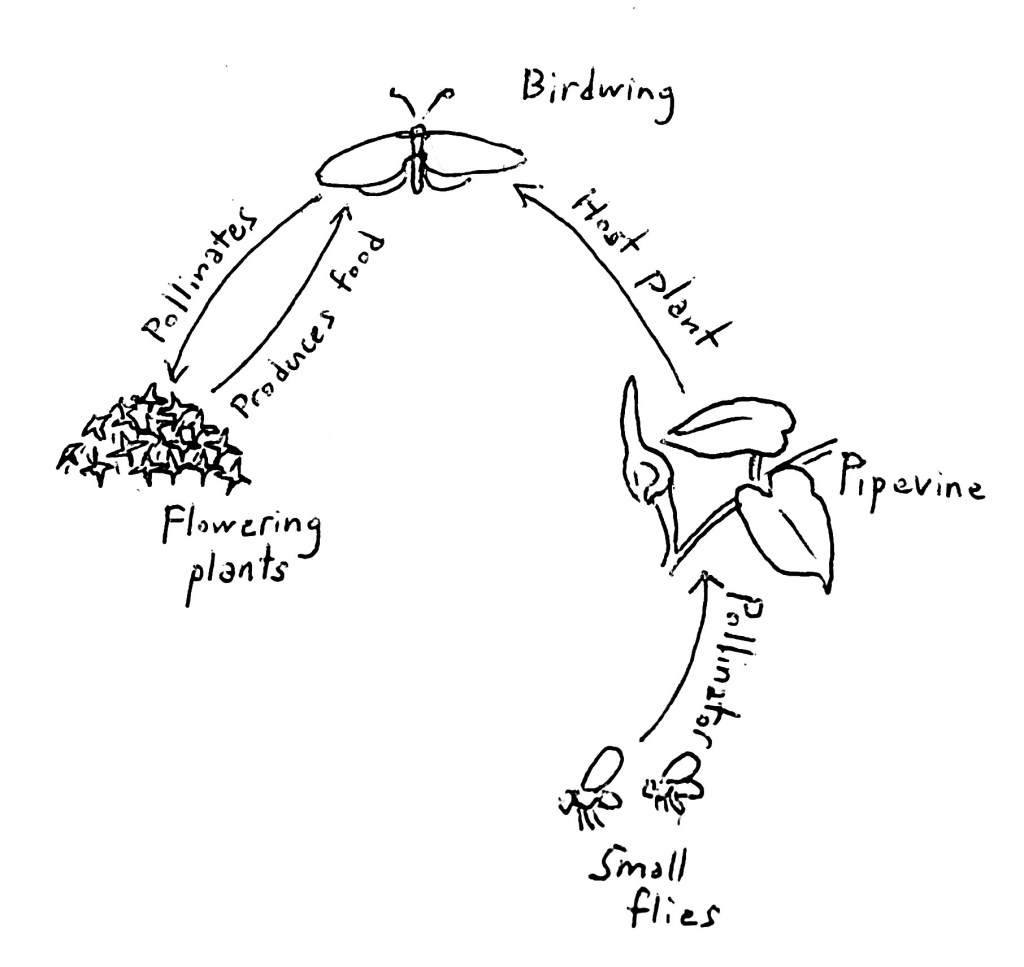
The special thing about the Rimba Ilmu ecosystem is that it has pollinators for the Pipevine, so the Pipevine can reproduce and replace the population that is lost to caterpillars. What is the pollinator of the pipevine? Tiny flies (Drosophilla spp., Megaselia spp.), which get caught in trap chambers in the flower of the Pipevine and forced to become pollinators without any reward. So a more viable ecosystem looks like this:
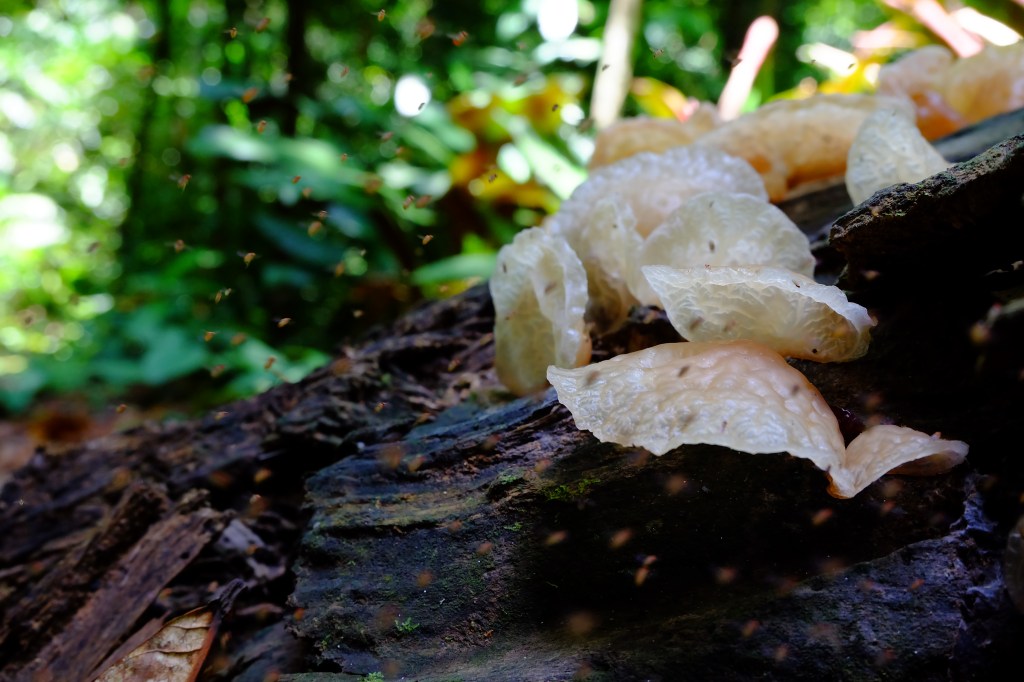
Of course since the Pipevine doesn’t feed them for the service of pollination, the fruit flies require their own food source, which is often rotten fruit, decomposing materials or fungus. These decomposition systems happen when there is enough fallen fruit, mulch and rotting logs in the overall ecosystem. This is supplied by leaves, fruit and branches falling off the plants in the system (which is an important reason to always leave some decomposition around). This results in this ecosystem:
The example above is a functioning, self sustaining ecosystem. As long as it gets enough sun it can keep going without any human interference. But the most interesting thing about this ecosystem is the fact that it assembled itself. While this “let nature find a way” approach is possible, we can help it along by being aware of the different parts and the needs of each part of the system. If you want butterflies in your garden, you need to think about more than butterflies.
Naturally occurring wildflower patches are the first step in succession. These small sun loving plants are usually the first to colonise bare land. They then help to regenerate the soil and make it suitable for secondary vegetation like shrubs and small trees to grow.
It should be stated that modern wildflower meadows are not native ecosystems. Many wildflowers found along our roads and in our fields are not native to Malaysia. Some are escaped ornamental plants that have gone wild, others have been brought accidentally by trade and a few have been introduced because of their usefulness to humans.
However, a patch of many small flowers and shrubs are more beneficial to pollinators and wildlife than just a lawn of grass. Stingless bee farms often encourage the growth of wildflowers such as Beggarsticks (Bidens alba, Biden pilosa), Coralvines (Antigonon leptopus), Goat weed (Ageratum conyzoides) and Cupids shaving brushes (Emilia sonchifolia) due to the nectar and pollen that they produce.
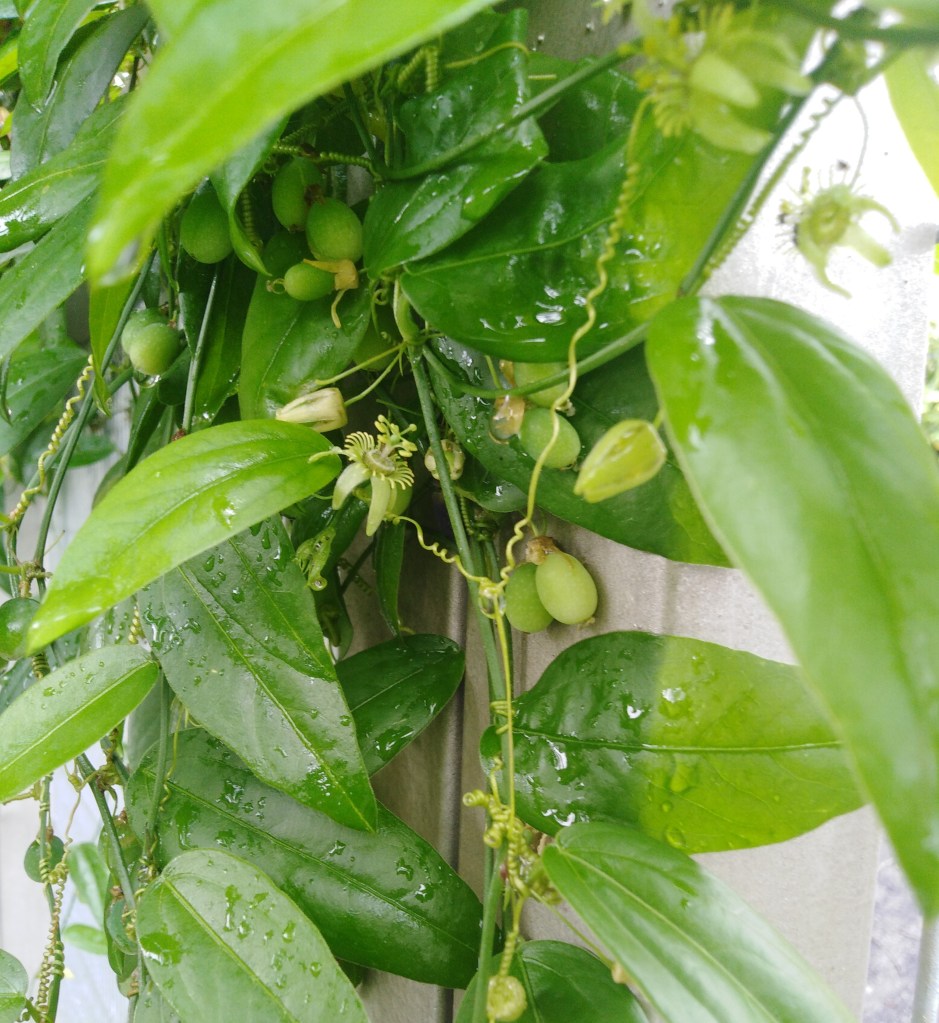
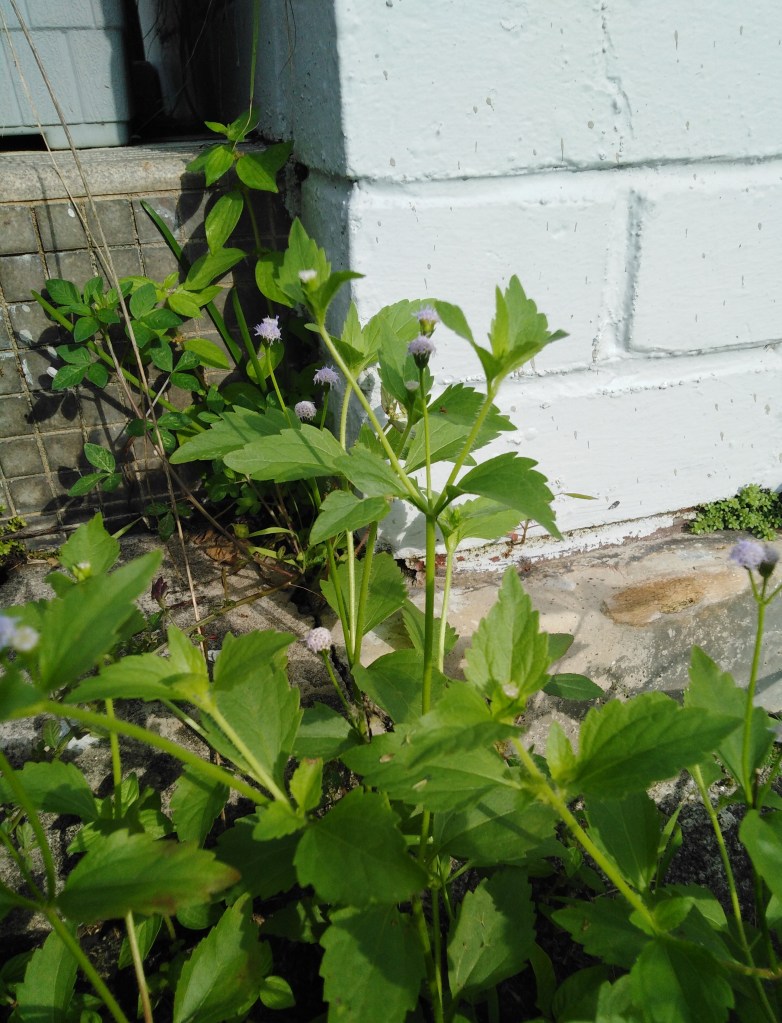
Corky passionflower (Passiflora suberosa) flower and fruits (left) and billygoat weed (Ageratum conyzoides) inflorescence (right).
Some wildflowers are also food plants adult butterflies and host plants for caterpillars. Passion flowers (Passiflora spp.) are the host plants for the Tawny Coster (Acraea terpescore) and Julia Heliconian (Dryas iulia), while the Touch-me-not plant (Mimosa pudica) is the host for Lesser Grass Blues (Zizina otis lampa) and the Peacock Pansy (Junonia almana).
Lavender Sorrel (Oxalis barrelieri)
Some wildflower patches produce fruit and seeds which are eaten by birds. The small sour fruit of the Lavender Sorrel (Oxalis barrelieri) are eaten by Zebra Doves (Geopelia striata) and other small birds. Insects such as grasshoppers, true bugs, crickets, ants and moths that hide in the wildflowers are also the food of insect eating birds. Occasionally smaller water birds will also forage these sites for insects too. Be careful if you intend to use any wildflowers, not all plants are safe to consume or use as medicines. Some wildflowers are harmful to humans and vertebrates, as they can contain poisons that can harm your liver or cause blindness. Be sure to ask an expert before you decide to use any part of a wildflower.
Star-of-Bethlehem (Hippobroma longiflora) produces toxic sap








 Urban Biodiversity Initiative (UBI)