Categories
Species Guide: Plants for Food

Temulawak

Flower cluster of Javanese turmeric
Photo credit: Kalpana Kalpana (CC BY-SA 3.0 License)

Common name: Javanese turmeric

Malay name: Temulawak

Local name: –

Scientific name: Cucurma zanthorrhiza

Distribution: East, South, and Southeast Asia, as well as Australia

Conservation status: Least concern, Cultivated, Naturalised.

Description

Temulawak is a unique variety of ginger that grows in tropical Asia. This plant is very much like usual ginger, but has the characteristic yellow tinge and taste bitter. As the name suggests, Java ginger originated from Indonesia, more specifically from Java Island. Currently, most of the Temulawak is cultivated in Indonesia, Malaysia, Thailand and Philippines.

Temulawak is a herbaceous, perennial plant.  It consists of a cluster of erect pseudostems up to 2 metres tall from an underground rhizome. Each pseudostem is made up of up to 8 leaves with blades that can be 40 – 90cm long and 15 – 21cm wide. The purplish, spike-like cluster of flowers sprout horizontally from the rhizome next to the leaf shoot, with 15 to 35 bracts (hardened, specialised leaves) arranged spirally, each containing a flower. The layers of bract turn purplish as they spiral up. This is different from the flower of ginger, which have greenish, spadix-like (resemble flower cluster of aroids) bracts with pale yellow, tubular flowers.

Precaution

Java ginger seems to be safe for most people when used for a short time, up to 18 weeks. Nonetheless, it may cause stomach irritation and nausea when used in large amounts or for long periods of time. For pregnant and breast-feeding individuals, please stay on the safe side and avoid using it. Besides, donโ€™t use Java ginger if you have liver or gall bladder problems, as it can increase the production of bile and worsen your condition. If you have gallstones, get medical advice before using it.

Culinary Uses

It can be eaten fresh and has a sourish, bitter taste. According to an article written by Juliana Harsianti, Temulawak is mostly used by beating the rhizome of this ginger and putting it into the dish being prepared. The rhizome of Temulawak contains curcuminoid, which is possibly useful to neutralise toxins, relieve joint pain, increase the secretion of bile and lower blood cholesterol.

The common use for this herb is to improve appetite, especially for children. To make a Temulawak potion, mash the rhizome and brew with tamarind and palm sugar, keep it boiling until only half the water remains.

Planting

The plant prefers slightly shady conditions and demands a moist, fertile soil which is rich in humus. Place the dried rhizome into the soil, covered up and donโ€™t forget to water it. Fertilise the soil with compost to get health plant growth.

Biodiversity Benefits

Curcuma species are known to be pollinated by several species of bees and butterflies, as well as attracting ants and beetles that are known to feed on the pollen. There are records of Hoeybees (Apis spp.) and Blue banded bees (Amegilia spp.) visiting these flowers. Dense plantings of gingers can be used to create natural screens or hedges. These provide shelter for small mammals, birds and frogs.

Related website:

  1. http://tropical.theferns.info/viewtropical.php?id=Curcuma+zanthorrhiza
  2. https://www.webmd.com/vitamins/ai/ingredientmono-532/javanese-turmeric
  3. https://www.healthbenefitstimes.com/javanese-turmeric/
  4. https://uses.plantnet-project.org/en/Curcuma_xanthorrhiza_(PROSEA)
  5. https://www.koop-phyto.org/en/medicinal-plants/turmeric.php
  6. https://www.99.co/blog/indonesia/cara-menanam-temulawak/
  7. http://ijprb.com/vol%2009%20(1)/7.aswani.pdf

Categories
Species Guide: Plants for Food

Selom

Divided leaves of selom. Photo by Goh Shang Ming

Common name: Java waterdropwort

Local name: Selom

Scientific name: Oenanthe javanica

Distribution: East, South, and Southeast Asia, as well as Australia

Conservation status: Least concern, Cultivated, Native

Description

Selom is a native plant found in the rainforest in Malaysia. Selom is an erect, perennial plant growing from 10 – 150 cm tall. The plant has creeping stolons by which it spreads vigorously, often forming large clumps. It bears small, white flowers in clusters. Selom often grows wild in swampy places such as the edge of wetland and rice field. However, there has been cultivation of Selom nowadays in response of market demand. It is rich in Vitamin C and minerals.

Culinary use

Selom was once a staple of Malay diets, freshly harvested leaves and stems were often served with a mix of Ulam raja, Pegaga or Tenggek burung as ulam. If you are a food lover, you should not miss the Northern Laksa or Laksa Utara in Peninsular Malaysia. The dish is normally presented together with fresh leaves of Selom.

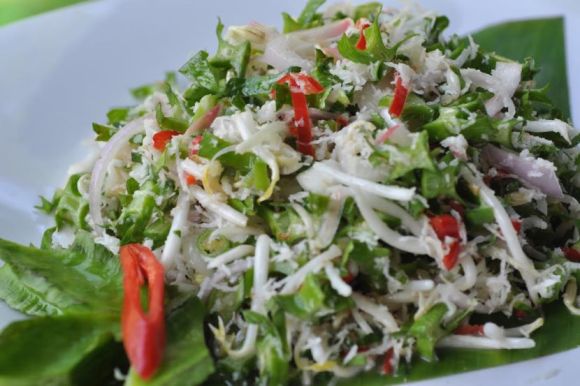
Other than that, the tender stems and leaf stalks of Selom are used fresh as salad, to garnish steamed rice and other dishes, or boiled and chopped as greens.

In the malay language, salad is known as kerabu

Planting

Selom is considered a plant that is easy to grow. It thrives in various type of soil. However, it is best to grow the plant in fertile, moist soil with high organic content. To plant selom in seed bed or nursery, the soil must be plowed before planting.

Propagation: Seed, cutting

Instead of planting with seed, planting with cutting is faster to get the yield. Young plant needs sufficient water to grow well. It is good to water the plant two times per day, morning and dusk. The cutting start to develop roots within 2 to 3 weeks. After 4 to 6 months, reduce the times of watering. You can harvest the plant after 3 to 4 months of planting in soil.

Disease

The most common found disease of the plant is Sooty mould. Therefore, take precautions on the sanitation and implement good farming practices e.g. keeping a distance among plants and removing unhealthy plants.

Benefits to biodiversity

As a small plant that grows in moist places, Selom makes for excellent shelter for small wetland animals such as frogs. It can also be planted near ponds to act as a shelter for fry and small fish. The small white flower clusters are attractive to pollinators like butterflies as well as short- and long- tongued bees.

Related websites:

  1. https://myagri.com.my/2017/12/selom/
  2. https://avrdc.org/water-dropwort-oenanthe-javanica/
  3. http://tropical.theferns.info/viewtropical.php?id=Oenanthe+javanica
  4. https://animhosnan.blogspot.com/2010/12/selom.html
  5. https://www.mstar.com.my/lain-lain/jamu-selera/2014/07/02/kerabu-selom

Categories
How-to

How to start a wildflower garden

The simplest method is to not do anything and let a patch regrow with wild plants. You can remove any unwanted or dangerous plants through weeding, but there is not much maintenance involved with these patches. A wildflower patch that needs to be tended by humans is an oxymoron.

If you want a bit more control over which wildflowers grow in your patch. You can harvest seeds from existing patches of wildflowers and scatter them into your plot. Wildflowers from the dandelion family (Asteraceaa) have dandelion like seeds that you can blow into your patch. Others have small seeds, fruit or pods that you can harvest when the turn mature and brown. Just break the pods and release the seeds onto the surface of your patch.

Transplanting wildflowers is a bit risky since they wilt very fast. Try to not expose the roots of the plants and collect it with its surrounding soil.  Make sure that your patch is moist and watered regularly during the first few days to ensure that your plants donโ€™t dry out. Some wildflowers grow by runners and can be planted similar to transplanting.

Not all your flowers might survive, but thatโ€™s perfectly fine. All plants require the correct amount of shade and the correct soil type. In other cases some of your plants will be outcompeted by other wildflowers or eaten by herbivores. These are all good learning opportunities to understand the ecology of these flowers better.

Try to allow a mix of different wildflower species to grow in your patch. This will make it more resilient and beneficial to the soil, as well as more useful to wildlife that forage for food in the patch.


This article is supported by The Habitat Foundation Conservation Grant

Categories
Uncategorized

Rewilding, the case of urban Birdwing butterflies

Here I explain how you can think about ecosystems and how to restore them. The case study of the Golden Birdwing Butterfly, which can be found in the urban forest patch that is Rimba Ilmu Botanic Garden located inside the University of Malaya.

Merely reintroducing a species does not produce long lasting results. Butterfly farms all over the country constantly have to restock wild caught butterflies due to captive butterflies dying and not reproducing. When an animal is placed in a system that does not meet its needs, thereโ€™s nothing much that it can do except go extinct.

The secret to the birdwings survival is the fact that it has a functioning ecosystem that produces resources can satisfy its ecological requirements.

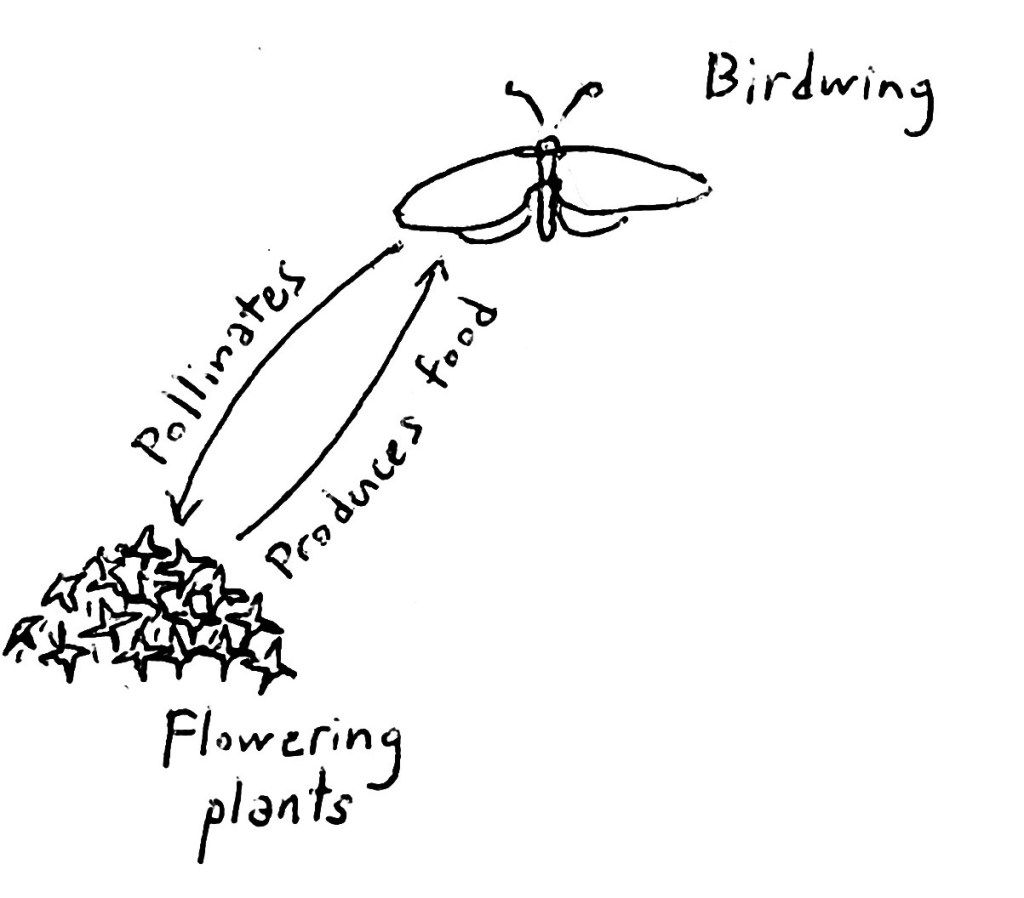
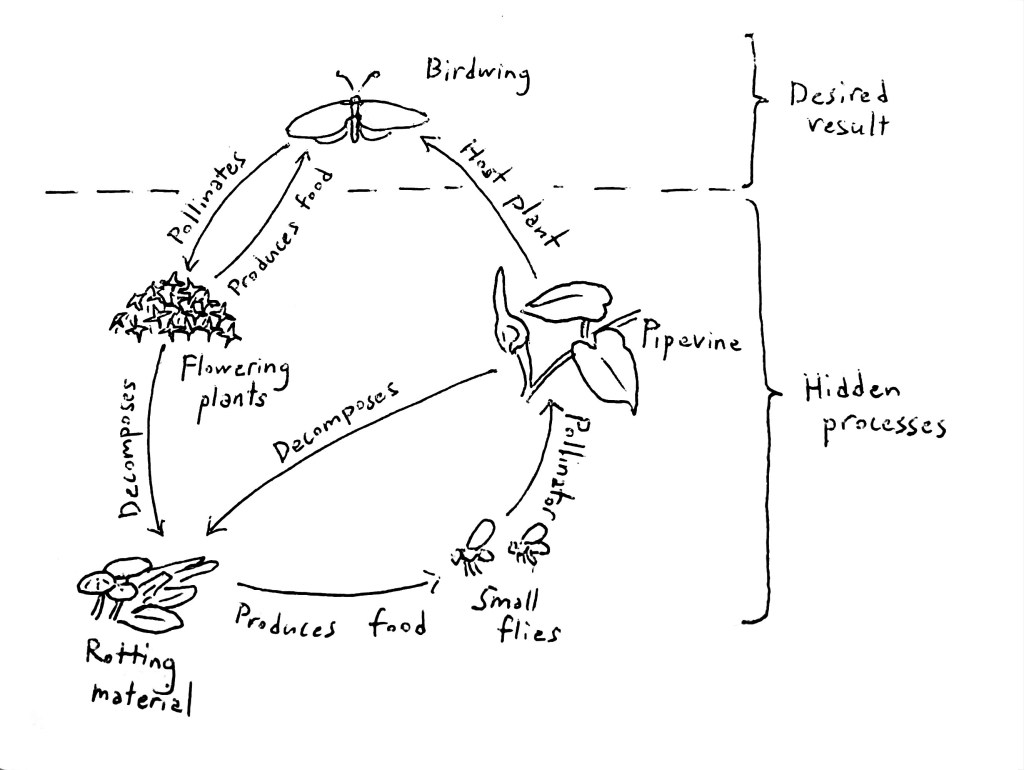
In a butterfly farm, the basic requirements for survival are met; the temperatures are suitable and there is enough food supplied through cut flowers and fruit. The ecosystem in a butterfly farm looks like this:

To be more sustainable and reduce the cost of having to feed the birdwings, you could plant food plants for the birdwings, so they can feed on the nectar. Birdwings prefer flowers that grow on in large clusters like Saraca, Ixora and Bauhinia kockiana so they can walk along and feed. The ecosystem would look this this:

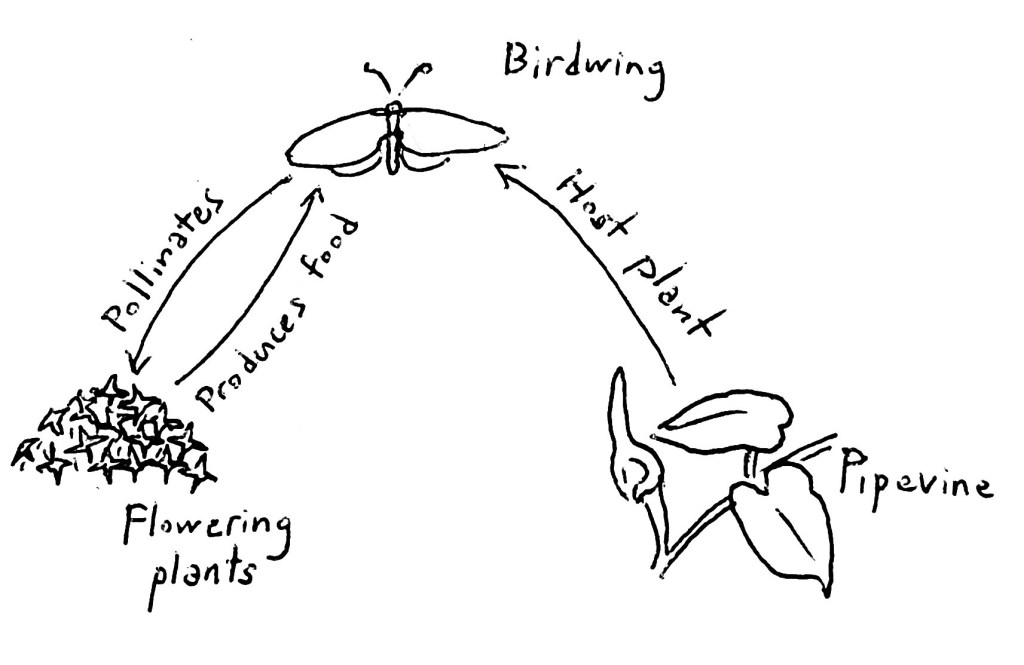
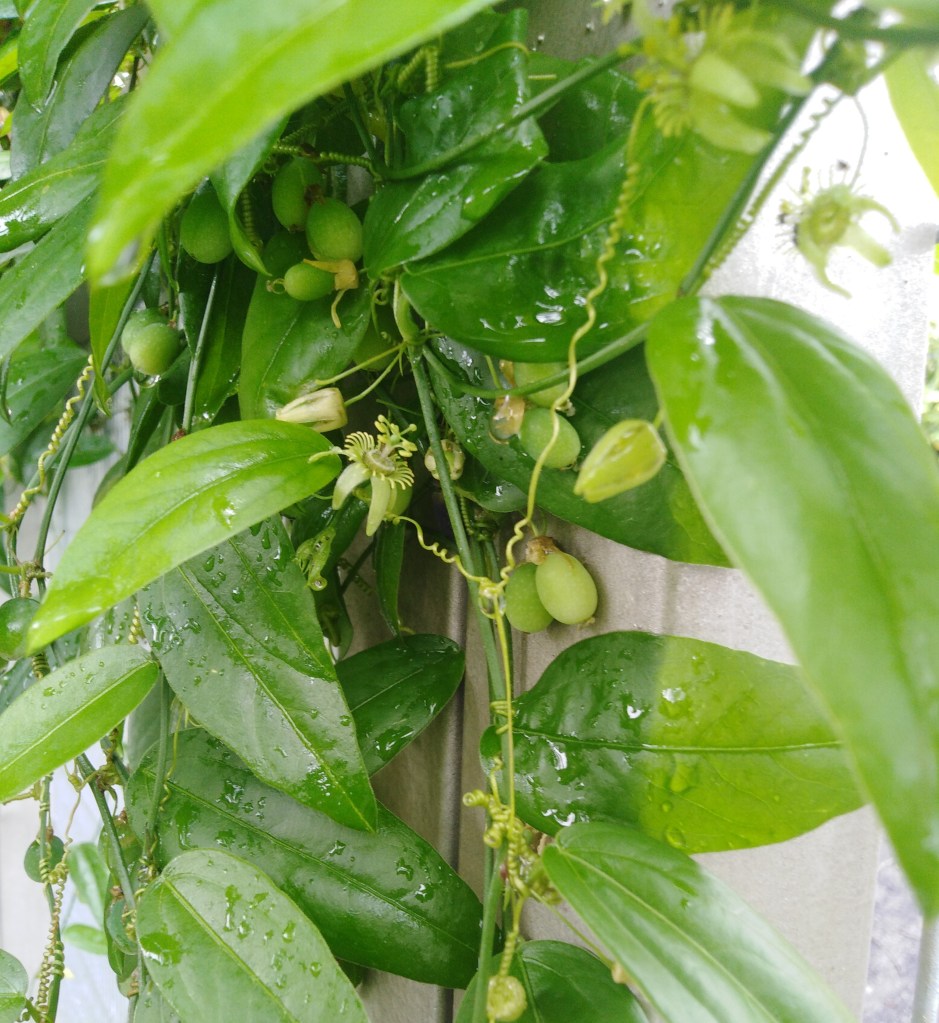
As mentioned before, once the end of the lifespan of the butterfly is reached the ecosystem collapses. This is because all butterflies require a host to develop on as a caterpillar, in this case the Birdwings are breeding on a climbing plant known as Pipevine (Aristolochia tagala). If supplied with a host plant, the butterflies can lay their eggs and reproduce and create a new generation. This ecosystem would look like this:

However, Birdwing caterpillars damage the stem once they are about to pupate into a butterfly. This behaviour is believed to increase the nutrient density of the leaves while reducing the water content. Because of that, the above ecosystem will also eventually collapse after enough caterpillars damage and kill off all their hosts.

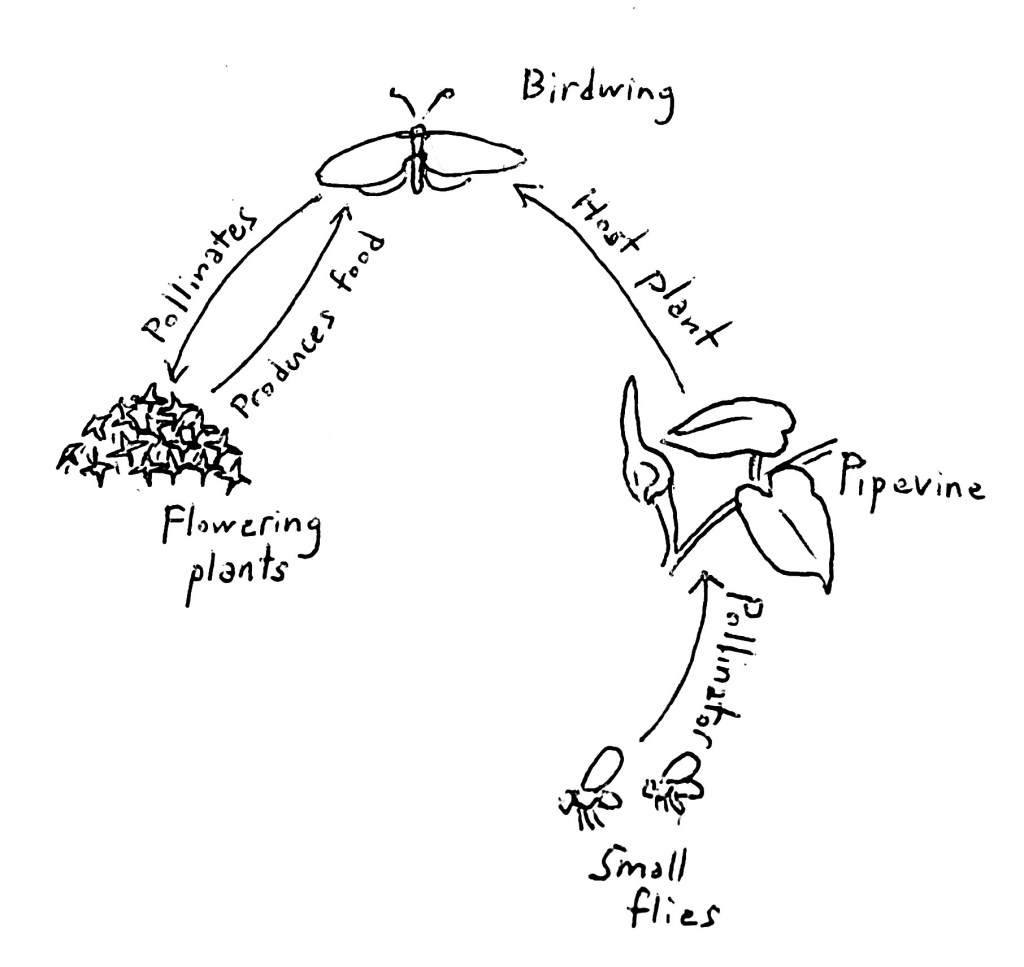
The special thing about the Rimba Ilmu ecosystem is that it has pollinators for the Pipevine, so the Pipevine can reproduce and replace the population that is lost to caterpillars. What is the pollinator of the pipevine? Tiny flies (Drosophilla spp., Megaselia spp.), which get caught in trap chambers in the flower of the Pipevine and forced to become pollinators without any reward. So a more viable ecosystem looks like this:

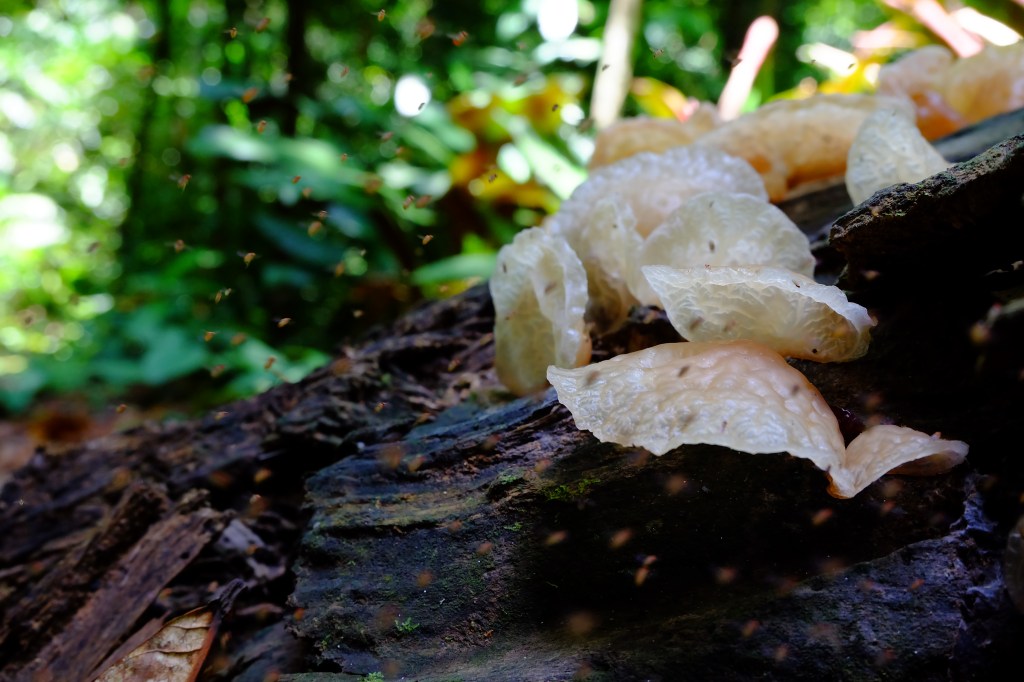
Of course since the Pipevine doesnโ€™t feed them for the service of pollination, the fruit flies require their own food source, which is often rotten fruit, decomposing materials or fungus. These decomposition systems happen when there is enough fallen fruit, mulch and rotting logs in the overall ecosystem. This is supplied by leaves, fruit and branches falling off the plants in the system (which is an important reason to always leave some decomposition around). This results in this ecosystem:

The example above is a functioning, self sustaining ecosystem. As long as it gets enough sun it can keep going without any human interference. But the most interesting thing about this ecosystem is the fact that it assembled itself. While this โ€œlet nature find a wayโ€ approach is possible, we can help it along by being aware of the different parts and the needs of each part of the system. If you want butterflies in your garden, you need to think about more than butterflies.

References:

http://rainforest-australia.com/birdwing.html


This article is supported by The Habitat Foundation Conservation Grant

Categories
Uncategorized

Wildflower meadows in Malaysia, a beginners guide

Naturally occurring wildflower patches are the first step in succession. These small sun loving plants are usually the first to colonise bare land. They then help to regenerate the soil and make it suitable for secondary vegetation like shrubs and small trees to grow.

It should be stated that modern wildflower meadows are not native ecosystems. Many wildflowers found along our roads and in our fields are not native to Malaysia. Some are escaped ornamental plants that have gone wild, others have been brought accidentally by trade and a few have been introduced because of their usefulness to humans.

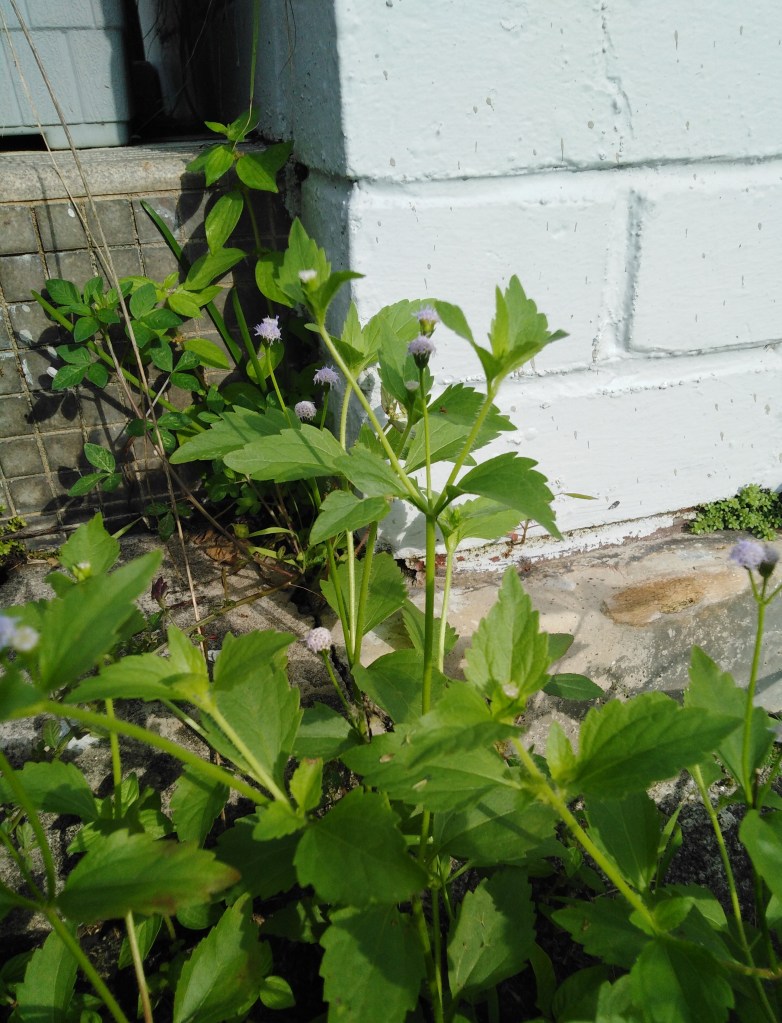
However, a patch of many small flowers and shrubs are more beneficial to pollinators and wildlife than just a lawn of grass. Stingless bee farms often encourage the growth of wildflowers such as Beggarsticks (Bidens alba, Biden pilosa), Coralvines (Antigonon leptopus), Goat weed (Ageratum conyzoides) and Cupids shaving brushes (Emilia sonchifolia) due to the nectar and pollen that they produce.

Some wildflowers are also food plants adult butterflies and host plants for caterpillars. Passion flowers (Passiflora spp.) are the host plants for the Tawny Coster (Acraea terpescore) and Julia Heliconian (Dryas iulia), while the Touch-me-not plant (Mimosa pudica) is the host for Lesser Grass Blues (Zizina otis lampa) and the Peacock Pansy (Junonia almana).

Lavender Sorrel (Oxalis barrelieri)

Some wildflower patches produce fruit and seeds which are eaten by birds. The small sour fruit of the Lavender Sorrel (Oxalis barrelieri) are eaten by Zebra Doves (Geopelia striata) and other small birds. Insects such as grasshoppers, true bugs, crickets, ants and moths that hide in the wildflowers are also the food of insect eating birds. Occasionally smaller water birds will also forage these sites for insects too. Be careful if you intend to use any wildflowers, not all plants are safe to consume or use as medicines. Some wildflowers are harmful to humans and vertebrates, as they can contain poisons that can harm your liver or cause blindness. Be sure to ask an expert before you decide to use any part of a wildflower.

Star-of-Bethlehem (Hippobroma longiflora) produces toxic sap

This article is supported by The Habitat Foundation Conservation Grant