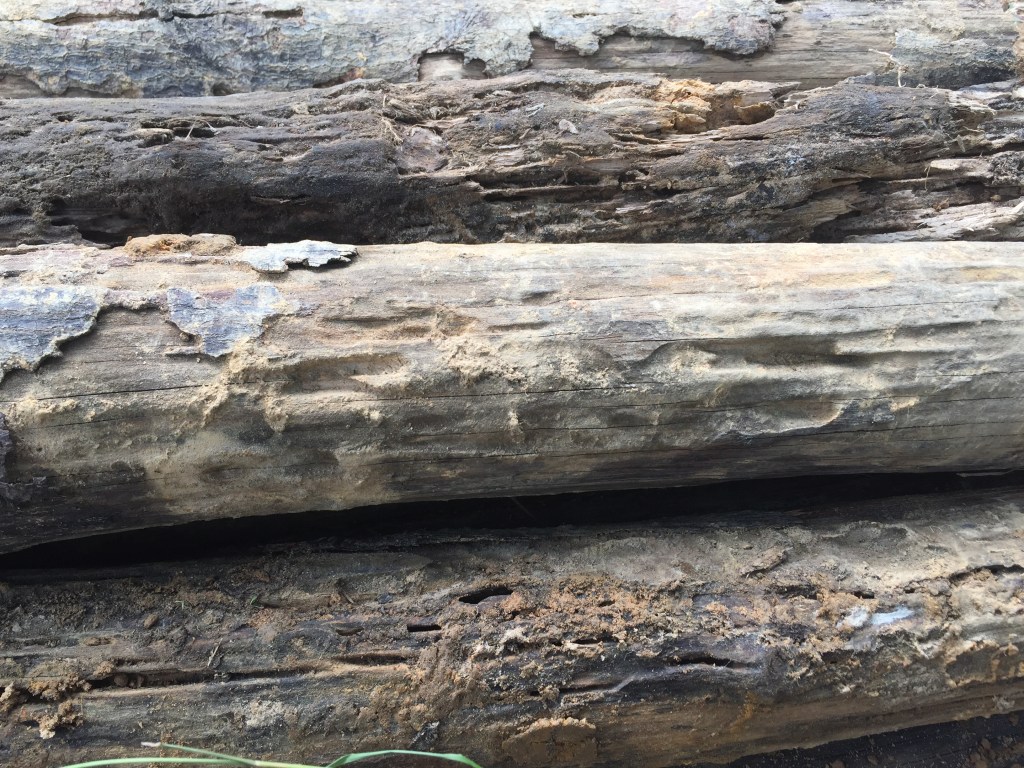
Rotting wood provides food and shelter for many animals.
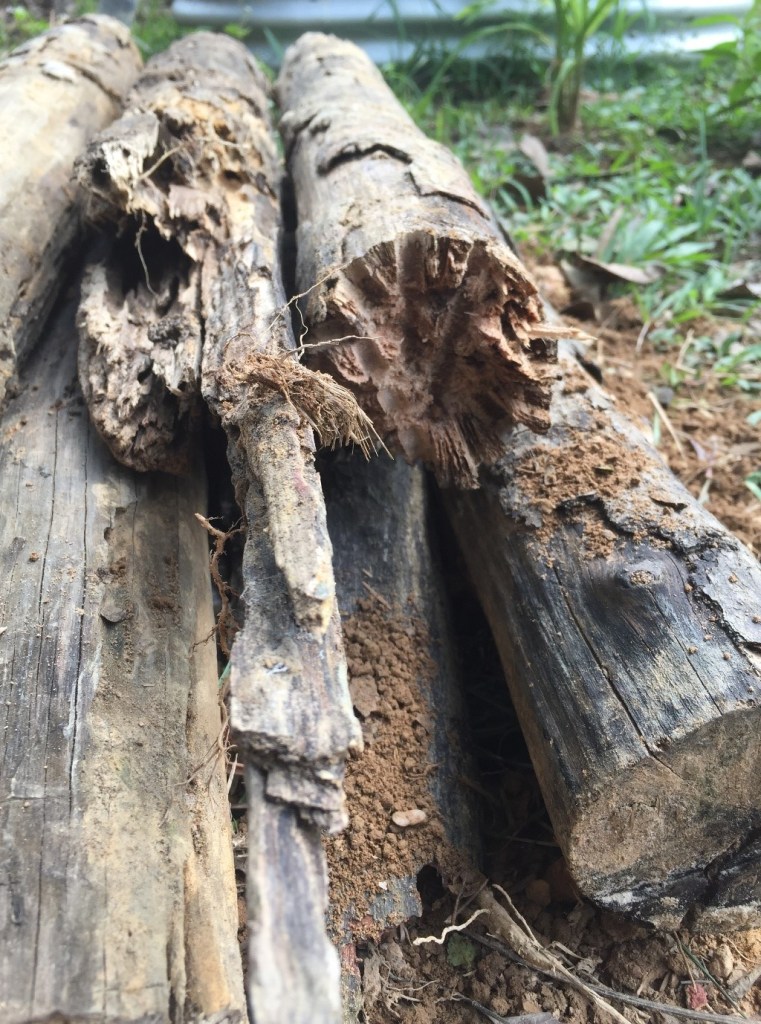
Log pile replicates a forest floor ecosystem. It creates the cool, moist and shady conditions for many ground-dwelling animals such as insects, snails and centipedes. If the log pile is close to a pond or a stream, it also attracts water-loving creatures such as frogs and toads.
Aside from being a shelter, log pile also provides food for animals. The dead, woody materials are food source of decomposers such as termites and fungi. Larger predatory animals such as birds feed on insects that live inside the log pile.
Choose a quiet, undisturbed part of the garden to create a log pile. It can be a corner of garden or back of a border. Make sure the log pile receives enough shade and moisture.
Dig out a sunken space to bury the logs. You can start by placing some upright logs under the soil. Also, pave the base with dry leaves as they create comfortable hiding places for animals such as frogs.
Dig a shallow hole to place the logs
Dry leaves help to regulate humidity of log pile
Next, stack large logs towards the center, with smaller ones and tree branches on top and around sides. Try to have at least 3 to 4 layers of logs. Add some leaf litter, dry grasses or soil to facilitate the formation of microhabitat.
The multi-layered log pile
It is up to you whether to stack the logs up neatly or randomly. Try to leave gaps of different sizes between the logs so that animals can find ideal spaces to rest or lay eggs.
Animals will live in the gaps between the logs.
After the log pile is established, leave it and make observation from time to time. You can water the log pile if it looks dry. Try to avoid human intervention so that decomposition and other natural processes can take place.
Continue adding logs to the log pile as the wood gradually rots down. That way you will have a range of wood types, from fresh, denser wood at the top to brittle, partially decomposed wood towards the bottom. Use natural, unprocessed wood. It is best to use logs from native species.
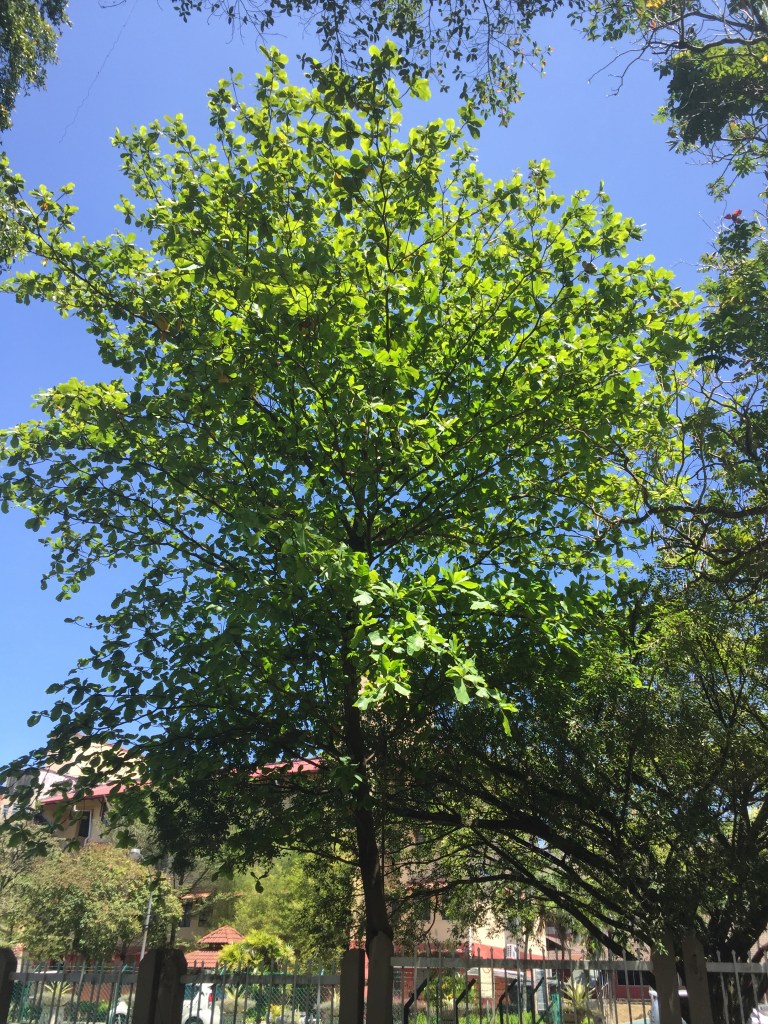
A Terminalia catappa with its pagoda-like tree crown. Photo by Goh Shang Ming
Common name: Indian Almond, Tropical Almond Tree
Malay name: Ketapang
Scientific name: Terminalia catappa
Conservation status: Cultivated, Native to Malaysia
Description
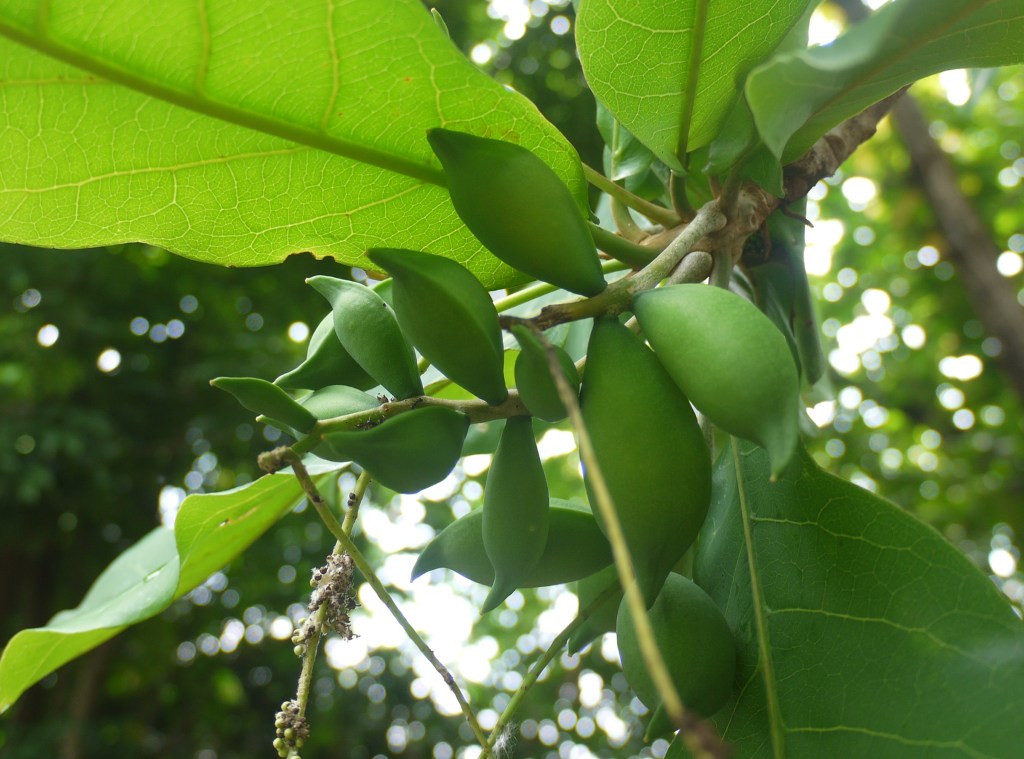
A large tree that grows up to 35 m tall. It is shaped liake a pagoda and sheds leaves twice a year. Leaves are spirally arranged, reverse-egg-shaped, papery to thinly leathery, dark green above and yellow-green below. The leaves turn red before falling. Bears small, fragrant, whitish flowers. Produces flat, egg-shaped fruits with a stony core that turns from green to yellow or red when ripe.
Green, almond-shaped fruits of Terminalia catappa. Photo by Goh Shang Ming
Star-shaped flowers of Terminalia catappa. Photo by Goh Shang Ming
Habit: Perennial tree
Cultivation: It is planted by seeds
Ecological function: The flowers attract pollinators. Fruits are eaten by bats
Pollinator: Insects
Soil: Sand, loam, clay. It can tolerate saline soils
Moisture: Moist, well-drained soil. The tree is drought-tolerant
A shrub or small tree that grows 3-15 m tall. Leaves are doubly divided. It bears white, hairy flowers arranged in round clusters. The tree produces long, flattened seed pods which turn from green to brown and burst open when ripe.
Habit: Perennial shrub or tree
Cultivation: It is planted by seeds or cuttings
Ecological function: The flowers attract generalist pollinators. The tree can fix nitrogen in soil. The leaves are rich in nitrogen and can be used as green manure. It is planted as a shade tree as well as a living fence. This plant is used to control soil erosion.
Pollinator: Insects
Soil: Sand, loam, clay
Moisture: Well-drained, fertile soils. This tree is drought-tolerant
A flowering african tulip. Photo by Goh Shang Ming
Common name: African tulip
Malay name: Pancut-pancut
Scientific name: Spathodea campanulata
Conservation status: Least concerned, Cultivated, Introduced (Tropical Africa)
Description
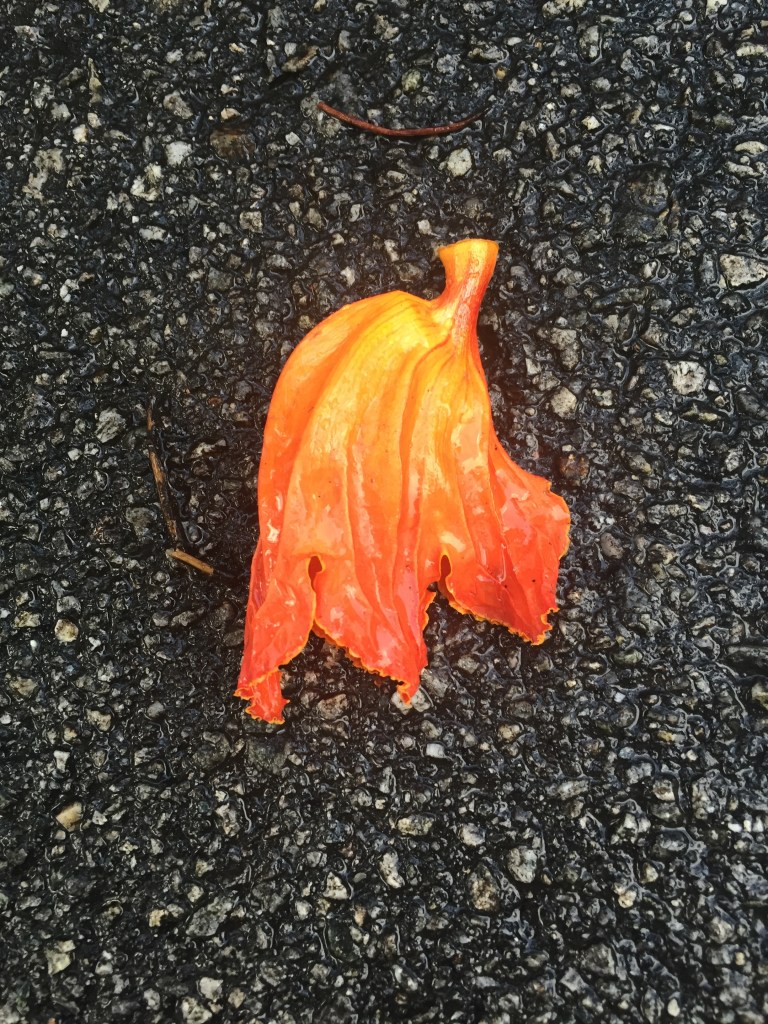
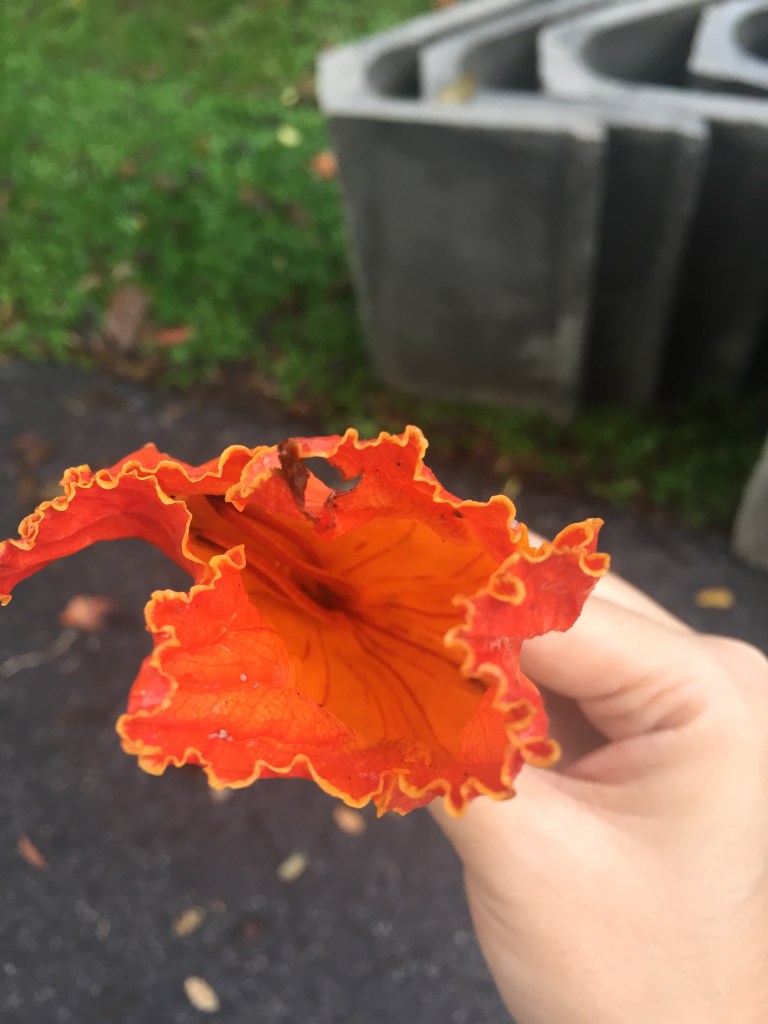
A medium-sized tree that grows 16-30 m tall. Tree crown is oval and bushy. Bear clusters of large, showy flowers. Flowers are somewhat bell-shaped, lobed, orange-red. Produces woody capsules that split when mature.
The bell-shaped flower of african tulip. Photo by Goh Shang Ming
The african tulip flower has a crinkled, yellow margin. Photo by Goh Shang Ming
Habit: Perennial tree
Cultivation: It is planted by seeds, cuttings, grafting or root suckers
Ecological function: The large, bell-shaped flowers attract pollinators like birds. The tree is shade-providing. It is used for soil improvement, reforestation and erosion control. It is planted as a living fence. The leaves of this tree make a useful mulch.
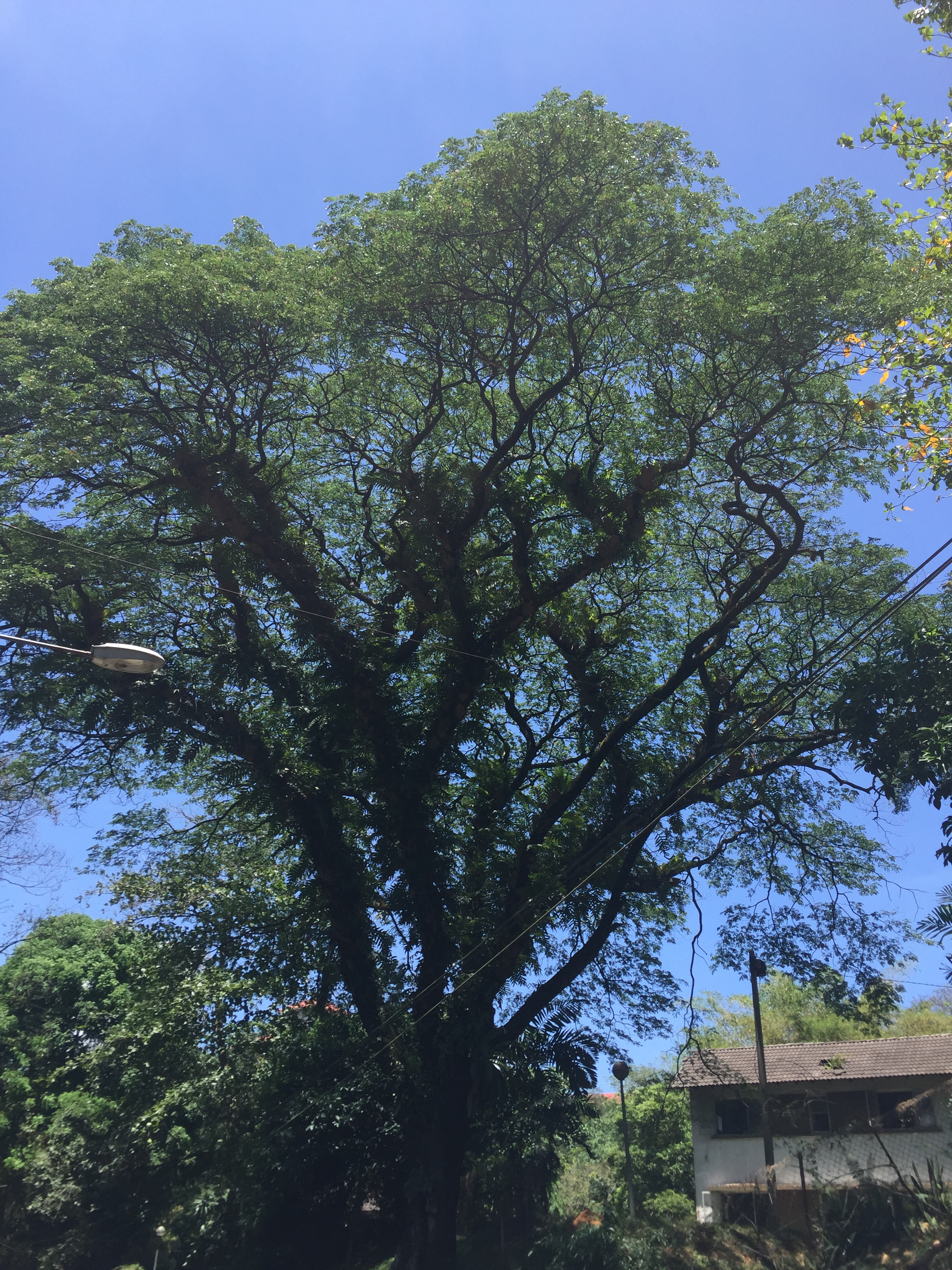
A majestic rain tree with its spreading crown. Photo by Goh Shang Ming
Common name: Rain Tree, Monkey Pod
Malay name: Pukul Lima, Hujan-Hujan
Scientific name: Samanea saman
Conservation status: Least concerned, Cultivated, Introduced (Tropical Americas)
Description
A medium-sized tree that grows up to 30 m tall. Tree crown is spreading and umbrella-shaped. Leaves are doubly divided, fold up in early morning and during cloudy days. It bears clusters of fluffy flowers with pink tips and white bases. Flowers are slightly fragrant. It produces seedpods that are black and break into segments when mature.
Habit: Perennial tree
Cultivation: It is planted by seeds, stumps or cuttings
Ecological function: The flowers attract pollinators. The tree is nitrogen-fixing i.e. able to convert atmospheric nitrogen into more usable form in soil. It provides shade. The prunings of this tree can be used as green manure to improve soil fertility. In Thailand, it is used as a host plant for Lac Insect (Laccifer lacca).
Pollinator: Bees
Soil: Sand, loam, clay. It can tolerate heavy clay and poor soils
Moisture: Dry, moist, wet soils. This tree is drought-tolerant
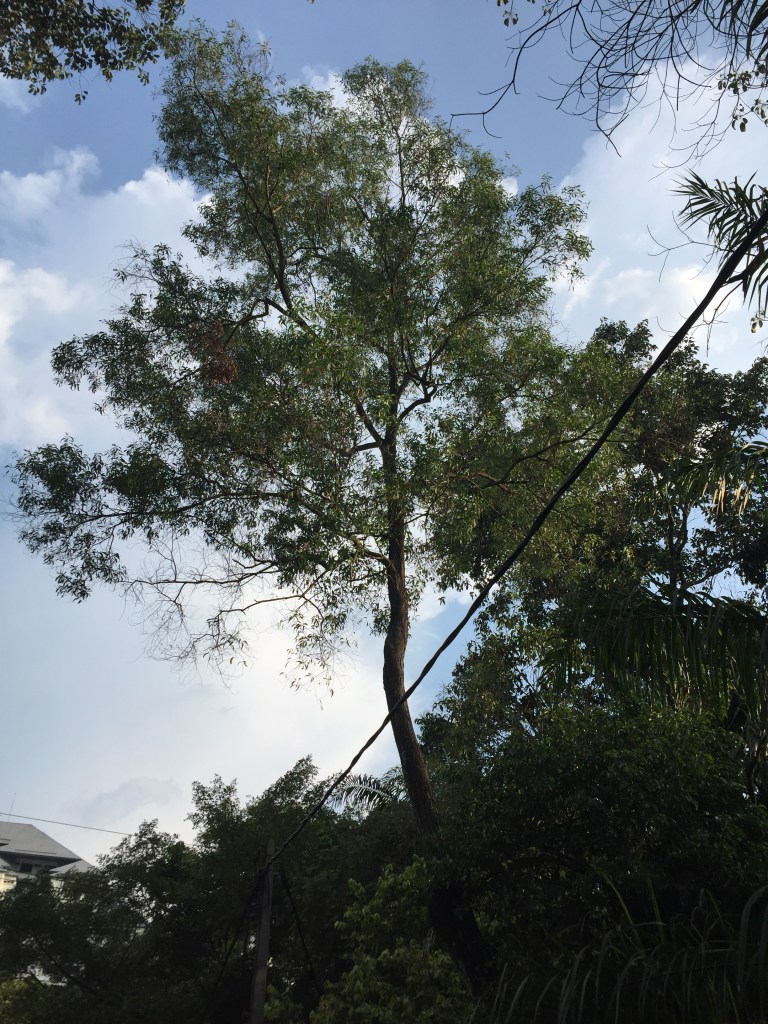
An earleaf acacia with its irregular tree crown. Photo by Goh Shang Ming
Common name: Earleaf Acacia, Black Wattle
Malay name: Akasia Kuning
Scientific name: Acacia auriculiformis
Conservation status: Least concerned, Cultivated, Naturalised, Introduced (Australia, Papua New Guinea and Indonesia)
Description
A medium-sized tree that grows up to 30 m tall. Tree crown is dense and irregular. Stems are crooked and twisted. Leaves are shiny and sickle-shaped. Bears rods of yellow flowers. Produces woody, twisted pods.
The tree creates dappled shade. Photo by Goh Shang Ming
Habit: Perennial tree
Cultivation: It is planted by seeds, cutting or air-layering
Ecological function: The flowers attract pollinators. The tree provides shade for other shade-loving plants. It is nitrogen-fixing i.e. convert atmospheric nitrogen into more usable form in soil. This tree is planted to control soil erosion.
Pollinator: Insects
Soil: Sand, loam, clay. It can tolerate saline soils
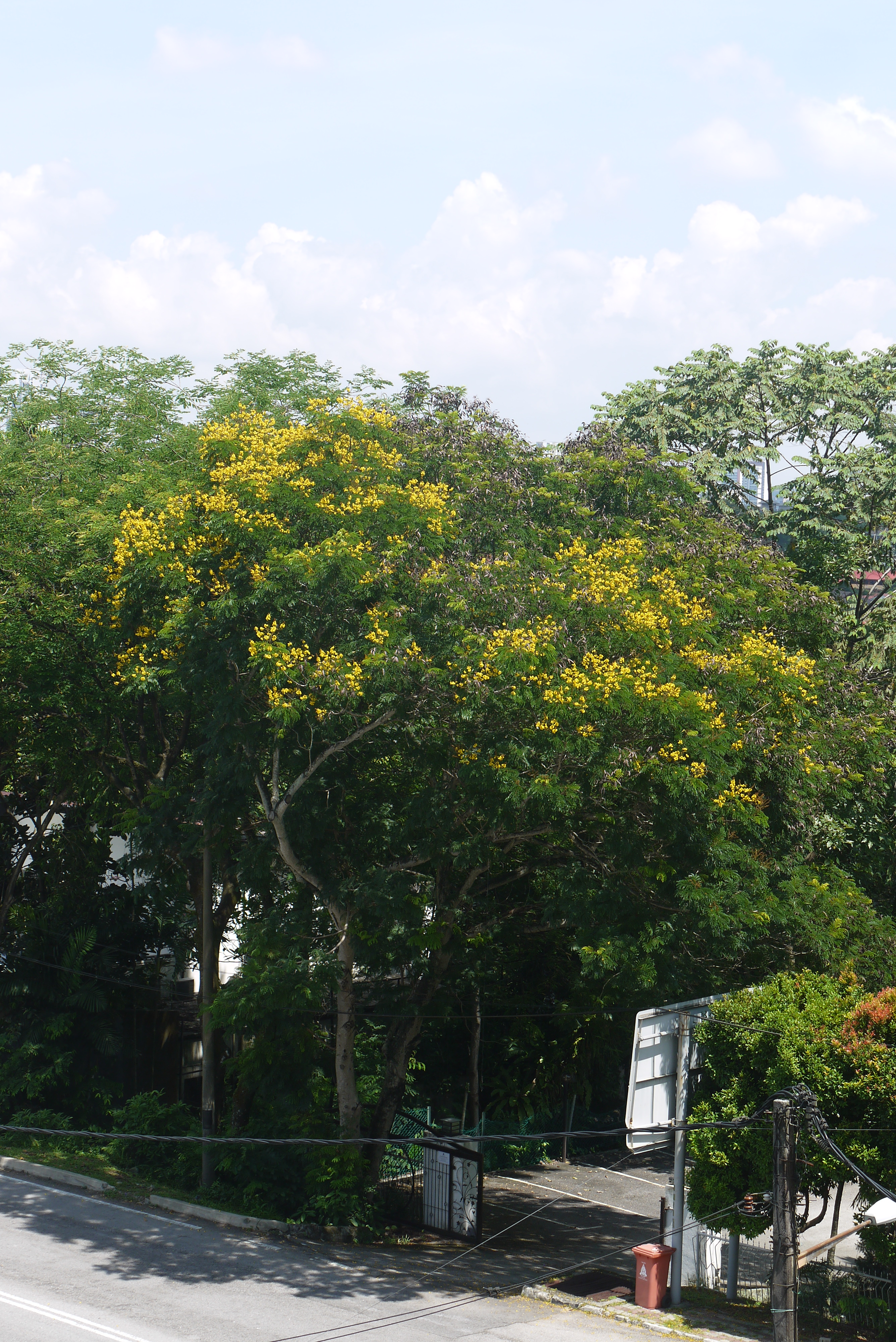
Yellow flame as a roadside tree. Photo by Goh Shang Ming
Common name: Yellow Flame, Yellow Flamboyant, Copper Pod
Malay name: Batai Laut
Scientific name: Peltophorum pterocarpum
Conservation Status: Cultivated, Native to Malaysia
Description
A medium-sized tree that grows up to 35 m tall. The tree sheds leaves seasonally. Tree crown is umbrella-shaped. Leaves are doubly divided. Flowers are fragrant particularly at night, bright yellow and arranged in clusters on upright stalks. The petals of flowers are crinkled and have reddish brown marks in the center. Bear flat, winged seedpods. The seedpods are red initially and turn black when ripe.
The crown of this tree is full of yellow flowers. Photo by Goh Shang Ming
Habit: Perennial tree
Cultivation: It is planted by seeds, cuttings or grafting
Ecological function: The flowers attract pollinators. The tree itself provides shade. It is nitrogen-fixing i.e. able to convert atmospheric nitrogen into more usable form in soil.
Pollinator: Bees, insects
Soil: Sand, loam, clay. It can tolerate heavy clay and saline soils
A wild cinnamon tree with a round, bushy crown. Photo by Goh Shang Ming
Common name: Wild Cinnamon
Malay name: Kayu Manis Hutan
Scientific name: Cinnamomum iners
Conservation status: Least concern, Cultivated, Native to Malaysia
Description
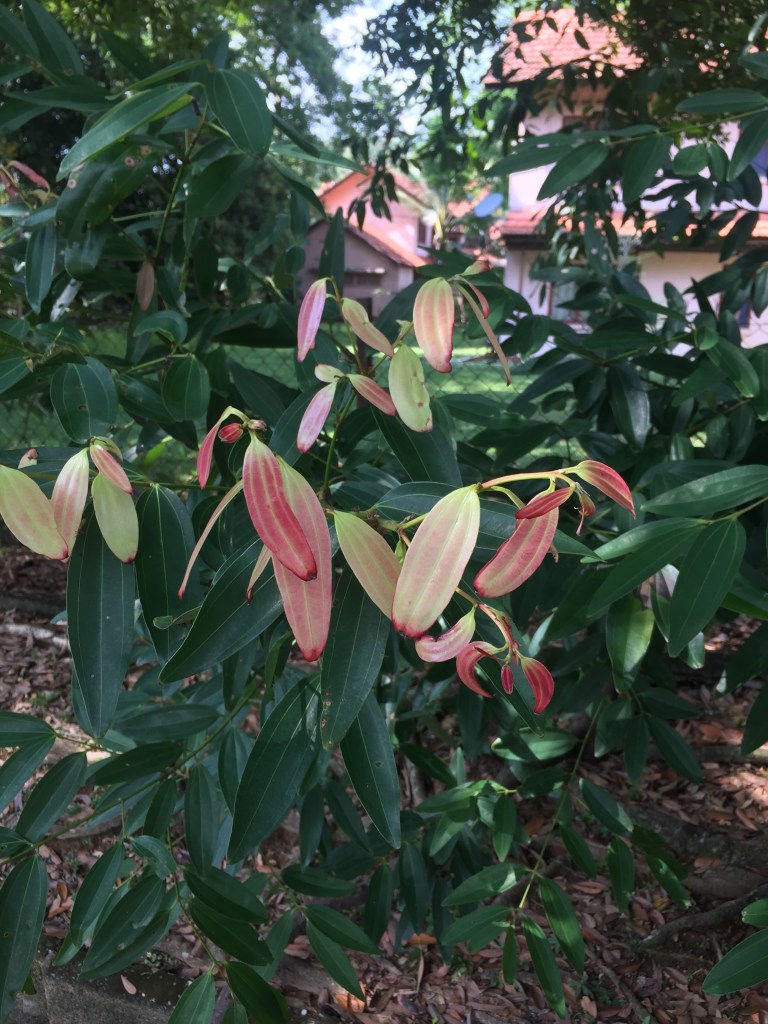
A small, evergreen tree of 10-15 m tall. It has a bushy, round tree crown. The bark of tree has a light, cinnamon-like fragrance. Leaves are pinkish when young but turn dark green eventually. Leaf shape is elliptic to oblong. Crushed leaves emit a cinnamon-like fragrance. Flowers are cream white, pungent and clustered. Bear round, fleshy berries that are initially dark green and turn purplish black at maturity.
Leaves are initially pinkish and turn green when mature. Photo by Goh Shang Ming
Habit: Perennial tree
Cultivation: It is planted by seeds or cuttings
Ecological function: The fruits are eaten by squirrels, bats and birds. It is a host plant (food plant of caterpillar) for Common Mime (Chilasa clytia clytia) and Common Bluebottle (Graphium sarpedon luctatius).
Pollinator: Hoverflies, small beetles and other small insects
Home gardening brings a couple of benefits to gardener as well as to environment. Here are some hardy, useful garden plants that require little maintenance:
Kangkung
Common name: Water spinach, Swamp morning glory
Malay name: Kangkung
Scientific name: Ipomoea aquatica
Distribution: South and Southeast Asia, tropical Africa, South and Central America and Oceania
Conservation status: Least concern, Cultivated, Native to Malaysia
Description
A perennial creeping plant growing up to 3 m long. Its stems are hollow and contain milky sap. Leaves are lanced-shaped, with 3 – 14 cm-long leafstalks. It produces funnel-shaped, whitish flowers. Fruits are round to egg-shaped, turn woody and brown when mature.
Precaution
The plants accumulate heavy metals when planted in polluted water.
Uses
Kangkung is a popular vegetable in Asia. Its leaves and young shoots are often cooked or eaten raw.
Planting
Kangkung survives in a wide range of soils, including heavy clays. It can grow in water. The plant needs a sunny position. It can be propagated by seeds or stem cuttings. Stems produce roots at nodes that come in contact with water or moist soil. It takes 2 to 3 weeks to develop lateral branches after sowing.
Biodiversity Benefits
The plant is pollinated by bees and butterflies. The plants are known to remove excess phosphorus from water bodies.
2. Ubi kayu
Common name: Tapioca, Cassava
Malay name: Ubi kayu
Scientific name: Manihot esculenta
Distribution: Tropics and subtropics worldwide
Status: Cultivated, Naturalised, Introduced (South America)
Description
A semi-woody shrub that grows up to 2 m tall. It has tuberous roots as storage organs. Leaves are palmately lobed and alternately arranged. Leafstalks are red and up to 60 cm long. Flowers are clustered and less attractive. It produces round, ridged fruits.
Precaution
The leaves of this plant contain a harmful chemical known as linamarin. This chemical can release the toxic hydrocyanic acid in the presence of the enzyme linase. Linamarin can be destroyed by heat.
Uses
Its young leaves and tubers are cooked as vegetables.
Planting
The plant can grow in either full shade, partial shade or no shade. Generally, a sand or sandy loam is preferred for growing this plant. It grows well in moist, well-drained soil. It can be propagated by seeds or cuttings. The plant can be harvested throughout the year. The roots take about six months to mature.
Biodiversity Benefits
The plant is pollinated by insects. A mulch of leaves and stems of this plant repels root knot nematodes.
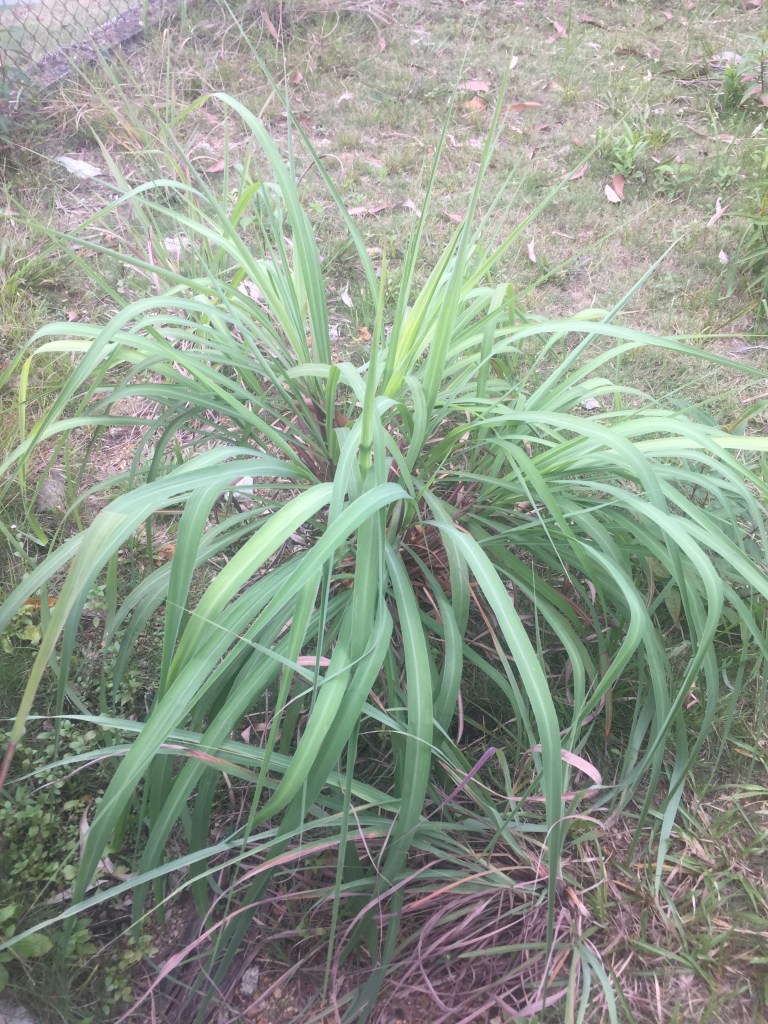
3. Serai
Common name: Lemongrass, Oil Grass, Fever Grass
Malay name: Serai
Scientific name: Cymbopogon citratus
Distribution: Africa, South and Central America, the West Indies, China and Southeast Asia
Conservation status: Cultivated, Native to Malaysia
Description
A clump-forming grass that grows up to 1-2 m tall when in flower. Leaf blades are strap-shaped and light green in colour. Crushed leaves emit a lemony scent. Small, brownish florets are hold together on drooping flowering clusters.
Precaution
–
Uses
Stalks are crushed and used as flavouring in a variety of Southeast Asian dishes such as curries and Tom Yam Soup. Leaves can be boiled to make tea. Essential oil extracted from the leaf stalks is used in cosmetics, pharmaceuticals and perfumery.
Planting
The plant needs a full sun position. It can grow in sand, loam or clay. It grows well in well-drained soils. The plant is propagated by seeds, divisions or stem cuttings.
Biodiversity Benefits
The plant can be used as groundcover.
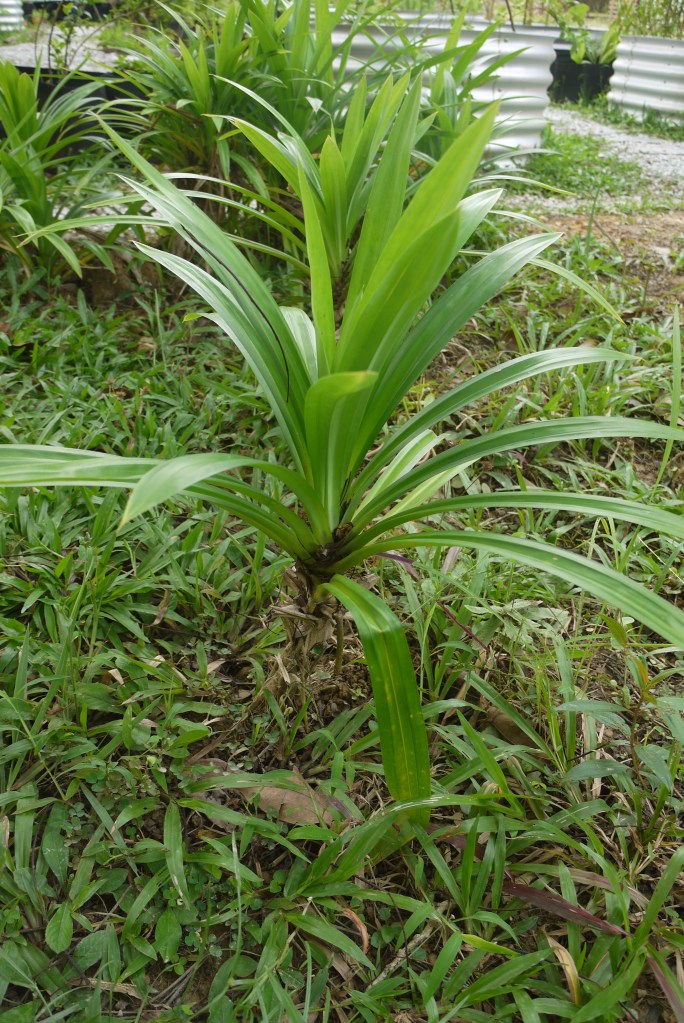
4. Pandan
Common name: Screwpine
Malay name: Pandan
Scientific name: Pandanus amaryllifolius
Distribution: Sri Lanka, Thailand, Vietnam, Malaysia, Indonesia (including Irian Jaya) and the Philippines
Conservation status: Cultivated, Native to Malaysia
Description
A shrub or small tree with long, linear, slightly pleated leaves. Leaves are spirally arranged.
Precaution
–
Uses
Young leaves of this plant are cooked and eaten. They are also used as food flavouring, colouring and wrapping material. Chopped leaves are mixed with flowers to make potpourris. People weave the leaves into baskets and sleeping mats. The essential oil extracted from the leaves has insect-repellent activity.
Planting
Pandan is planted by suckers i.e. side shoots that emerge from the base or lateral bud of a plant. The plant grows well in fertile, well-drained loamy soils. It needs a full sun or partially sheltered environment. Harvesting may start about 6 months after planting and may continue for several years.
Biodiversity Benefits
Pandan is food plant for caterpillars.
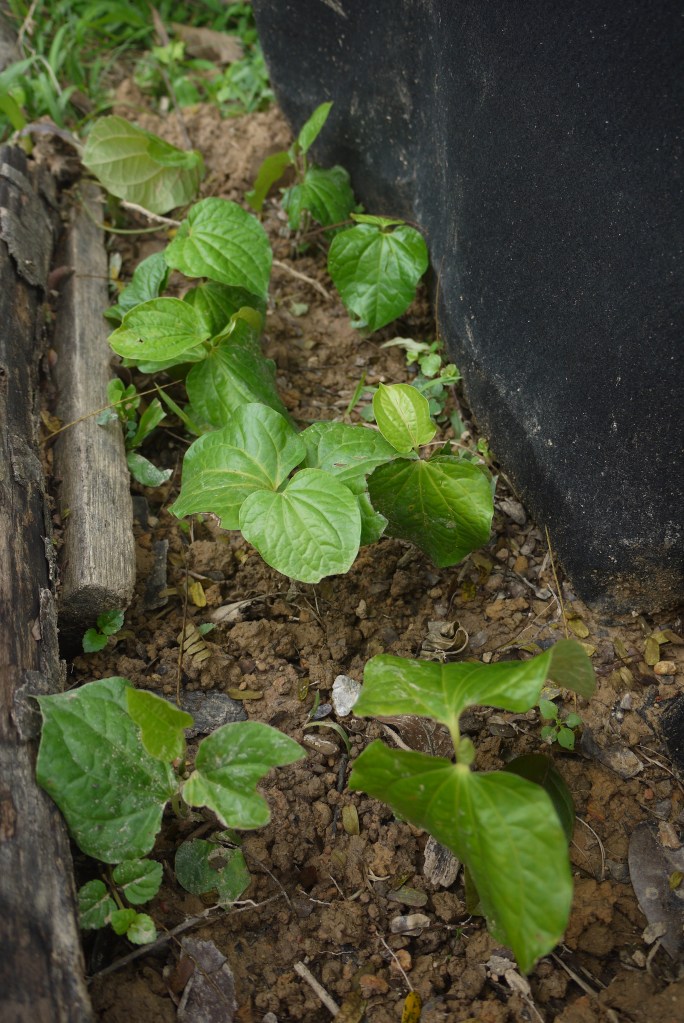
5. Kadok
Common name: Wild Pepper, Wild Betel
Malay name: Kadok
Scientific name: Piper sarmentosum
Distribution: Andaman Islands, southern China, Southeast Asia (from the Philippines southward to the Moluccas.)
Conservation status: Cultivated, Native to Malaysia
Description
A creeping plant that form mounds of up to 60 cm in height. Stems are erect and slightly hairy. Leaves are glossy, dark green, heart-shaped and alternately arranged. Crushed leaves emit a peppery scent. Flowers are white, without petal, borne on cylindrical flowering shoots. It produces small, dark green fruits.
Precaution
–
Uses
The leaves of this plant are either eaten raw or cooked. They give a nice peppery flavour. Larger leaves are lightly steamed and used as food wraps. Fruits and stems are also edible.
Planting
Kadok is propagated by seeds or transplanting. It needs shady environment. It grows well in moist, well-drained, fertile loamy soils. The plant needs spaces to roam and crawl.
Biodiversity Benefits
Kadok is pollinated by animals. It can grow as an understory shrub (a branched, woody plant between forest canopy and forest floor) or groundcover.
Some fruits that often appear on our dining tables are commonly found in our home gardens. These fruit trees bear edible fruits and provide shade for people. Actually, common fruit trees are beneficial to environment as well.
Animals use different parts of the trees to feed, rest and lay eggs. Some fruit trees such as Limau Kasturi (Citrus × microcarpa) and Rambutan (Nephelium lappaceum L.) provide food for caterpillars of various butterflies and moths. Fruit-eating animals like to visit fruit trees such as Mango (Mangifera indica), Papaya (Carica papaya L.) and Cempedak (Artocarpus integer).
A papaya tree
Aside from animals, common fruit trees also create suitable growing conditions for other plants. Some large, densely crowned trees allow saplings and shade-loving plants to grow underneath. Deep-rooted plants like Nangka (Artocarpus heterophyllus Lam.) help to maintain soil structure.
Many common fruit trees are native to Malaysia. They grow naturally in the forest. For example, the wild bananas (Musa spp.) are relatives of domesticated bananas. Their fruits are less edible to humans. However, these wild species are important genetic resources as they can contribute beneficial traits e.g. pest or disease resistance for improving production of cultivated bananas.
A wild banana plant with blossom and fruit cluster











 Urban Biodiversity Initiative (UBI)